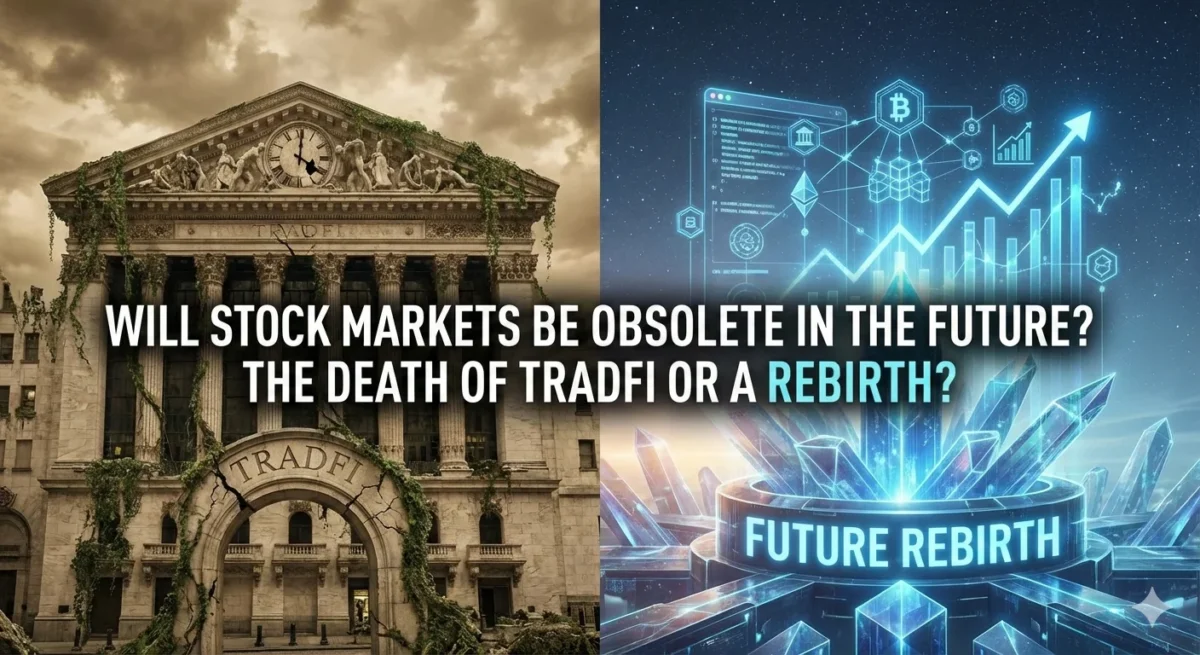
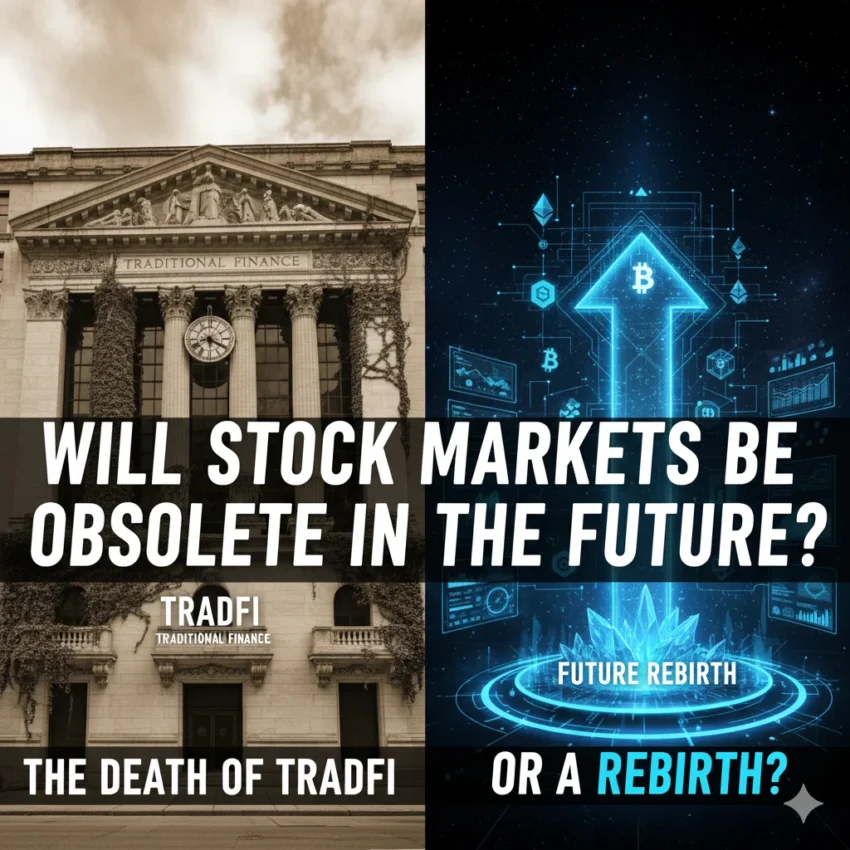
Will Stock Markets Be Obsolete in the Future? The Death of TradFi or a Rebirth?
Imagine a world where the New York Stock Exchange is a museum, and the concept of “ringing the opening bell” is as antiquated as sending a telegram. It sounds like science fiction, but with the rapid ascent of Decentralized Finance (DeFi), Artificial Intelligence (AI), and tokenization, investors are asking a chilling question: Will stock markets become obsolete in the future?
The short answer is no—but the long answer is that the stock market as you know it is already dying. It is shedding its skin to emerge as something faster, more transparent, and radically different.
In this deep dive, we will explore the technological tsunamis threatening traditional exchanges, the arguments for their survival, and what the financial ecosystem of 2050 might actually look like.
Will Stock Markets Be Obsolete in the Future? : The “Obsolete” Argument: Why Are We Even Asking This?
To understand if stock markets will vanish, we must first understand why they exist. Traditionally, stock markets served two main purposes: capital formation (companies raising money) and liquidity (investors buying/selling assets).
For over a century, centralized exchanges like the NYSE, Nasdaq, and LSE have held a monopoly on these functions. However, cracks are forming in the foundation.
1. The Gatekeeper Problem
Traditional markets are exclusive clubs. High fees, accredited investor requirements, and geographical borders lock out billions of potential participants. If a farmer in Kenya wants to buy Apple stock, the barriers are immense. New technologies promise to demolish these gates, making the “middleman” model of current exchanges look inefficient and predatory.
2. The 9:30 to 4:00 Dilemma
In an era of instant global communication, why does the stock market close? Crypto markets run 24/7/365. The concept of “after-hours trading” feels archaic to a generation raised on continuous connectivity. The rigidity of traditional market hours is a major friction point that modern alternatives are solving.Will Stock Markets Be Obsolete in the Future? The Death of TradFi or a Rebirth?
Will Stock Markets Be Obsolete in the Future? : The Three Horsemen of Disruption
Three specific technologies are currently dismantling the traditional stock exchange model. These are not distant theories; they are active disruptors.
1. Blockchain and The Tokenization of Everything
This is the single biggest threat to the status quo. Blockchain technology allows for the “tokenization” of real-world assets (RWAs). Instead of a paper share stored in a central depository (like the DTCC in the US), a stock becomes a digital token on a blockchain.
- Why it threatens exchanges: If a company can issue tokenized equity directly to investors on a blockchain (like Ethereum or Solana), they don’t need an expensive exchange listing. Smart contracts can automatically handle dividends and voting rights.
- The T+0 Revolution: Current stock trades take days to “settle” (T+1 or T+2). Blockchain offers atomic settlement (T+0), meaning the trade and the transfer of ownership happen instantly. This eliminates billions of dollars in counterparty risk and collateral requirements.
2. Decentralized Finance (DeFi) & AMMs
Automated Market Makers (AMMs) like Uniswap have proven that you don’t need a centralized order book to trade assets. Liquidity pools allow users to trade peer-to-contract rather than peer-to-peer.
While currently used mostly for crypto, imagine an AMM for Tesla stock. No broker, no clearinghouse, just code. If regulatory hurdles clear, DeFi protocols could technically host global equity trading far more cheaply than the Nasdaq.
3. Prediction Markets vs. “Investing“
A surprising challenger has emerged: Prediction Markets (e.g., Kalshi, Polymarket). Some experts argue that the stock market is increasingly becoming a venue for gambling rather than long-term investing.
If the primary goal of a trader is to bet on outcomes (e.g., “Will Company X succeed?”), prediction markets offer a cleaner, more direct way to do that than buying equity. While they won’t replace the need for capital raising, they could siphon off a massive chunk of retail trading volume, rendering the speculative arm of stock markets less relevant.
Why Stock Markets Will Likely Survive (But Mutate)
Despite the allure of DeFi, it is highly unlikely that stock markets will go extinct. Instead, they will evolve. Here is why the “Obsolete” theory often fails.
1. The Trust and Regulation Moat
The “Wild West” nature of crypto is its Achilles’ heel. Billions of dollars are lost to hacks, rug pulls, and smart contract exploits. Institutional investors (pension funds, sovereign wealth funds) manage trillions of dollars. They cannot legally or ethically park that money in unregulated smart contracts. Traditional stock exchanges offer a layer of regulatory safety and recourse that code cannot yet match. Until DeFi can guarantee the safety of assets to the level of the SEC, the NYSE is safe.
2. The Price Discovery Mechanism
Stock markets are incredibly efficient at pricing assets based on earnings, data, and public sentiment. While blockchain changes how we trade, it doesn’t change what we trade. Companies still need a venue to prove their value to the public. Centralized exchanges provide a standardized, high-volume arena for this price discovery that fragmented liquidity pools struggle to replicate for large-cap stocks.
3. Hybridization: The “New” Stock Market
We are already seeing the merger of old and new. Major financial players like BlackRock are filing for Bitcoin ETFs and exploring tokenized money market funds. The future isn’t Stock Market vs. Blockchain. It is Stock Market running ON Blockchain. In the future, the Nasdaq might essentially be a frontend interface for a permissioned blockchain network. You will still trade “stocks,” but the backend plumbing will be completely different.
Will Stock Markets Be Obsolete in the Future? : Vision 2050: What Will the Market Look Like?
If we fast-forward 25 years, the concept of a “Stock Market” will be unrecognizable compared to today.
- Global 24/7 Access: The opening bell will be symbolic. Trading will be continuous, global, and accessible to anyone with an internet connection.
- Fractionalization: You won’t just buy a share of Amazon. You might buy $5 worth of a specific revenue stream from Amazon’s cloud division, tokenized and sold separately.
- The Death of Brokers: The role of the retail broker (like Robinhood or Charles Schwab) will diminish. AI agents will likely execute trades directly on decentralized protocols to find the best liquidity, bypassing traditional intermediaries.
- DAOs as IPOs: We may see a decline in traditional IPOs (Initial Public Offerings) in favor of DAOs (Decentralized Autonomous Organizations), where capital is raised via token sales with governance rights built into the code.
People Also Ask (PAA)
Here are answers to the most common questions regarding the future of stock markets.
1. Will crypto replace the stock market?
Not entirely. Crypto and stock markets serve different purposes. Crypto is often a store of value or a utility for a network, while stocks represent ownership in a productive company. However, crypto technology (blockchain) will likely become the underlying infrastructure for the stock market, meaning stocks will eventually be traded as crypto tokens.
2. Is the stock market dying?
No, the stock market is not dying; it is maturing. While the number of publicly listed companies has decreased in recent years (due to private equity and high regulation costs), the total market capitalization continues to grow. The market is shifting from a public-heavy model to a mix of public, private, and tokenized assets.
3. How will AI change stock trading in the future?
AI will likely make human “day trading” obsolete. Algorithmic trading already accounts for the vast majority of volume. In the future, AI personal finance agents will manage portfolios, execute trades, and rebalance assets in real-time based on your risk profile, removing human emotion and error from the equation.
4. What will replace the stock exchange?
It is unlikely to be replaced but rather upgraded. The most likely successor is a Distributed Ledger Technology (DLT) Exchange. This would be a regulated platform that uses blockchain for instant settlement and transparency but retains the oversight and compliance of a traditional exchange.
5. Can the stock market crash to zero?
Theoretically, yes, but practically, no. For the market to go to zero, every publicly traded company in the world would have to go bankrupt simultaneously. Since the stock market represents the productive output of the global economy, a value of zero would imply the total collapse of modern civilization, at which point money would be the least of your worries.