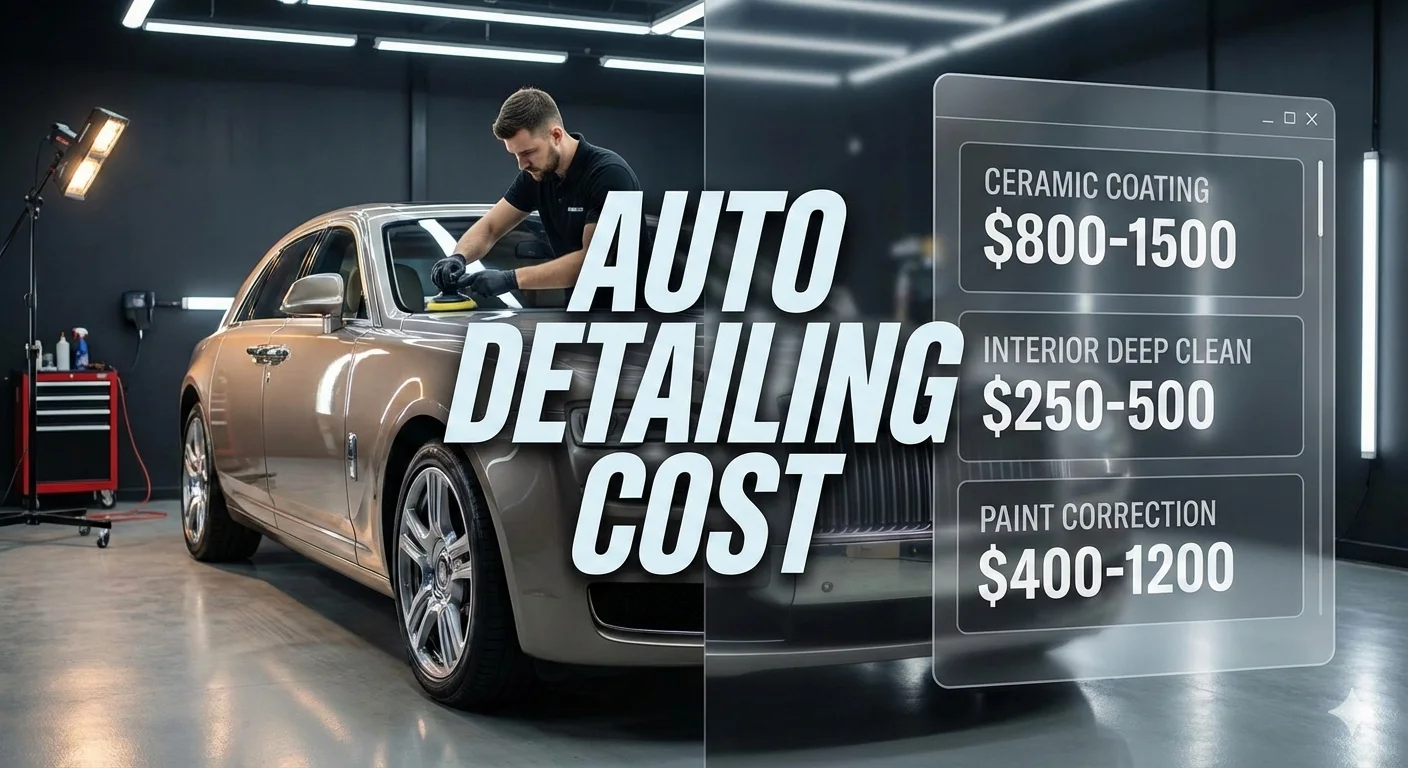
What Is Auto Detailing — And Could It Actually Be a Business Worth Starting?
This guide explains what auto detailing really involves, what separates a good detailer from a great one, and how everyday people are turning it into full-time income. Whether you want a cleaner car or a new career, here’s everything you genuinely need to know — including real pricing, startup costs, income data, and the honest tradeoffs of each business model. No fluff, no hype. Just a clear look at what this work actually takes and whether it’s right for you.
What Is Auto Detailing
The first time most people hear the word “detailing,” they picture someone with a chamois and a bucket, charging three times what a car wash costs. That impression isn’t entirely wrong — but it misses most of what detailing actually is.
Real auto detailing is a skilled trade. It’s part cleaning, part restoration, part protection work — and when it’s done properly, the results are genuinely hard to believe. Cars that looked beyond saving come out looking like they just rolled off a showroom floor. And increasingly, it’s an industry people are walking into not just as customers, but as business owners.
The numbers back that up. The US auto detailing market was valued at $14.7 billion in 2024 and is projected to grow at a CAGR of 5.5% through 2030, according to IBISWorld. That growth isn’t driven by people suddenly caring more about clean cars — it’s driven by the fact that vehicles are more expensive than ever, and owners are paying attention to protecting what they’ve invested in.
So whether you’re trying to understand what you’re actually paying for at the detailing shop, or you’re quietly wondering whether this could be your next career move, here’s the real picture.
What Auto Detailing Actually Means — Day to Day
The simplest honest definition: detailing is the process of cleaning, correcting, and protecting a vehicle at a level that a standard car wash simply cannot reach.
A car wash removes surface dirt. Detailing gets into the paint, the upholstery, the door jambs, the vent slats, the carpet pile — anywhere grime hides. But more importantly, detailing doesn’t just clean. It corrects. Scratches. Swirl marks. Oxidation. Faded trim. Foggy headlights. A skilled detailer addresses these things in ways a pressure rinse and a squeegee never could.
The Three Core Services in Auto Detailing
Most detailing operations are built around three service categories:
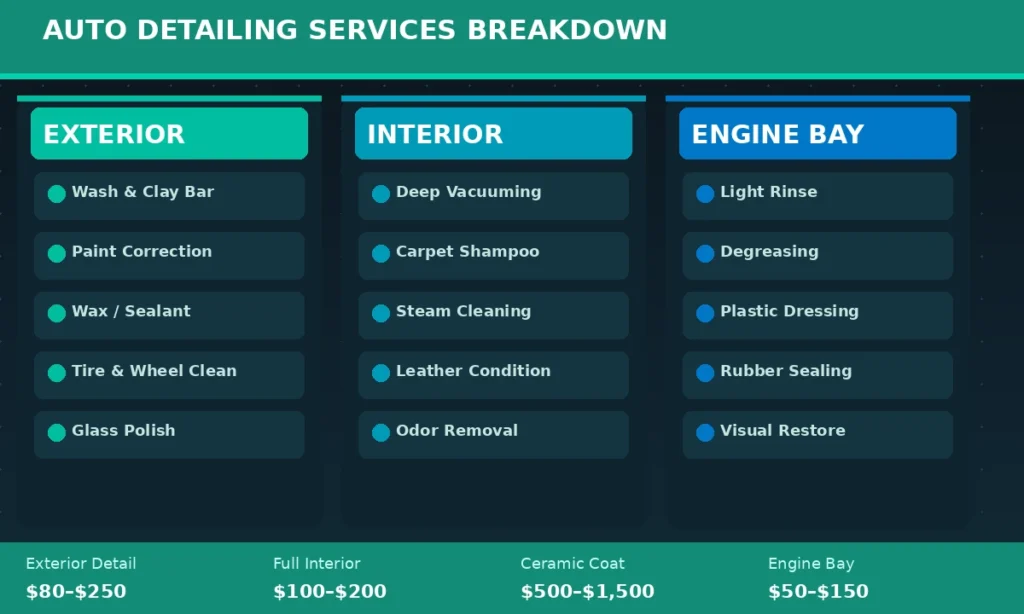
Exterior Detailing — This is the most visible work and often what people think of first. A proper exterior detail goes far beyond washing. It starts with a hand wash using pH-balanced shampoo and microfiber mitts (never brushes that scratch), moves into a clay bar treatment to pull embedded contaminants from the paint surface, and then into paint correction — machine polishing to remove swirl marks and fine scratches. It finishes with a protective layer: wax, synthetic sealant, or ceramic coating depending on the customer’s budget and goals. Tire dressing and glass cleaning round it out.
Interior Detailing — The inside of a car takes more abuse than the outside, and it shows. Interior detailing typically involves deep vacuuming, shampoo extraction on carpets and upholstery, steam cleaning to kill bacteria and lift odors, leather conditioning, dashboard and console cleaning, and full glass work inside. For cars with pet hair, smoke damage, or years of neglect, it can be genuinely transformative work.
Engine Bay Cleaning — Often sold as an add-on, engine bay detailing removes grease buildup, degreases components, and applies dressings to plastic and rubber. It’s less about aesthetics and more about accessibility — a clean engine bay is simply easier to work on — but it looks impressive and customers love it.
Why People Actually Pay for Detailing (It’s Not Just Vanity)
Yes, a freshly detailed car looks incredible. But there are real, practical reasons people invest in this service beyond wanting their car to look nice.
Resale and Trade-In Value — According to Kelley Blue Book, a professionally detailed vehicle can command $500 to $2,000 more at resale than a comparable car that hasn’t been maintained cosmetically. For a $30,000 vehicle, that’s a meaningful return on a $200–$400 service.
Paint Longevity — Wax and sealants block UV radiation, prevent oxidation, and slow paint degradation. Ceramic coatings take this further, creating a semi-permanent hydrophobic layer that repels water, dirt, and minor abrasion. A car that’s regularly protected ages significantly better than one that isn’t.
Health and Air Quality — This one gets overlooked. Interiors collect dust mites, mold spores, pet dander, bacteria from food spills, and allergens trapped in carpet and upholstery. A proper interior detail removes all of it. For people with allergies or anyone who spends significant time in their car, this matters more than the shine.
Simple Enjoyment — There’s no sophisticated economic argument needed for this one. A clean car just feels better to drive. People report less stress on commutes, feel more professional when clients see their vehicle, and genuinely enjoy the experience more. That’s worth something.
Auto Detailing by the Numbers
| Service Type | Average Price Range | Time Required | Skill Level |
|---|---|---|---|
| Basic exterior wash | $30–$60 | 1–2 hours | Beginner |
| Full interior detail | $80–$180 | 2–4 hours | Intermediate |
| One-step paint correction | $150–$300 | 3–5 hours | Intermediate |
| Multi-stage paint correction | $400–$900 | 6–16 hours | Advanced |
| Ceramic coating (entry-level) | $500–$1,000 | Full day | Advanced |
| Ceramic coating (premium) | $1,000–$2,500 | 1–3 days | Expert |
| Headlight restoration | $50–$120 | 1 hour | Beginner |
| Engine bay detail | $50–$150 | 1–2 hours | Beginner–Intermediate |
Sources: Detailing Success Report 2024, IBISWorld, National Detailing Association
How to Actually Start an Auto Detailing Business
Here’s where the conversation shifts from “this is interesting” to “this is possible.” Auto detailing has one of the lowest barriers to entry of any skilled trade. You don’t need a degree. don’t need a shop. You don’t need $50,000. it only need skills, tools, and a willingness to work.
But — and this matters — you do need to actually learn the craft before you start taking money from people. Rushing into this with the wrong technique or the wrong product on the wrong paint can cause real damage. Paint correction done incorrectly creates more scratches than it removes. Leather cleaned with the wrong chemical dries out and cracks. This is skilled work, and that skill has to be built before you charge for it.
How to Build the Skills Without Going to School
Most working detailers didn’t attend a formal program. They learned by:
- Watching professional detailers on YouTube (channels like Pan The Organizer, Apex Detail, and Junkman have thousands of hours of real-world content)
- Practicing obsessively on their own vehicle and family cars
- Working part-time or for free under an experienced detailer to understand real workflow
- Taking structured online courses through platforms like Detail King or the Auto Detailing Network
The learning curve is real but manageable. Most people are confident enough to charge for basic services within three to six months of consistent practice.
Choosing Your Business Model — The Honest Tradeoffs
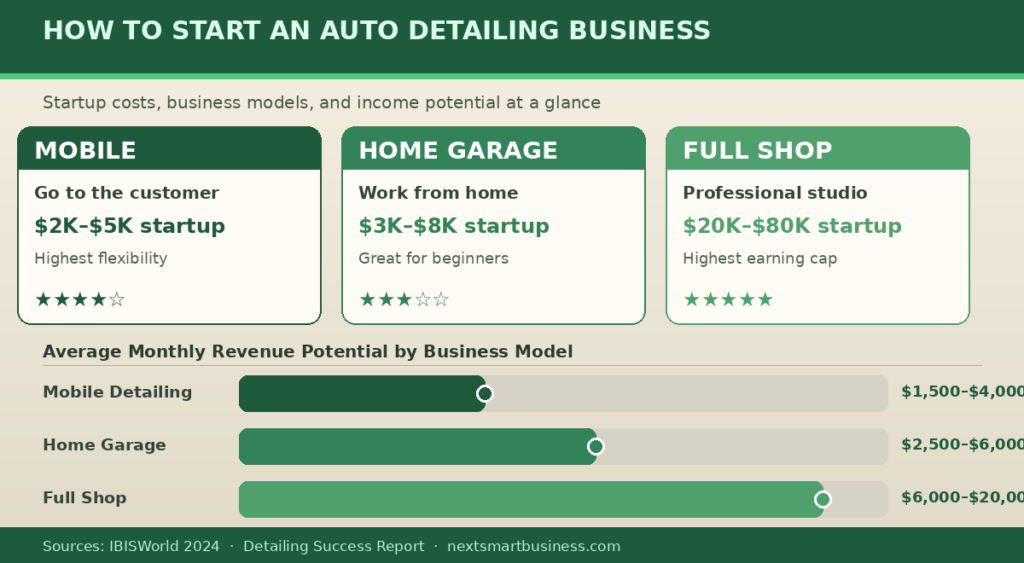
This is one of the most important decisions you’ll make, and it depends entirely on your financial situation and lifestyle.
Mobile Detailing is where most people start. You drive to the customer — their driveway, their office parking lot — and do the work there. Startup costs are low ($2,000–$5,000 for a solid basic setup), flexibility is high, and overhead is nearly zero. The limitation is that you need to manage water and power logistics, and weather creates real scheduling headaches.
Home Garage Setup is the middle ground. You work from home, which gives you a controlled environment without commute costs. It works beautifully if your garage setup is right and your local zoning allows it. Startup costs run $3,000–$8,000 for a proper setup. The main friction is customer perception — some people hesitate to bring their car to a residential address until they’ve seen your work.
Full Detailing Shop is the long-term build. Higher earning potential, professional environment, ability to hire staff and serve multiple clients simultaneously. The tradeoff is real: $20,000–$80,000 in startup costs, ongoing rent, utilities, and the operational complexity of running an actual facility. This is where experienced detailers expand after proving their business model works.
H3: What Does a Detailing Business Actually Earn?
| Business Model | Monthly Revenue (Avg.) | Annual Revenue Potential | Overhead Level |
|---|---|---|---|
| Mobile (solo) | $2,500–$5,000 | $30K–$60K | Very Low |
| Home Garage (solo) | $3,500–$7,000 | $42K–$84K | Low |
| Small Shop (1–2 staff) | $8,000–$18,000 | $96K–$216K | Medium |
| Established Shop (3+ staff) | $20,000–$50,000+ | $240K–$600K+ | High |
Sources: IBISWorld Industry Report 2024, Detailing Success Revenue Survey
Top-performing solo detailers — those who specialise in ceramic coatings and paint correction — regularly report $80,000–$120,000 in annual revenue working alone.
Getting the Legal Side Right (Before You Take a Single Job)
This part bores people, and that’s exactly why so many detailers skip it and regret it later. Setting up properly takes a day and protects you indefinitely.
At minimum you need: a registered business entity (LLC is the standard choice for liability protection), a local business license, general liability insurance (critical — you are working on assets worth tens of thousands of dollars), and an understanding of your local water runoff regulations. Most municipalities have rules about how wash water is disposed of. Mobile detailers in particular need to know these rules, as fines can be steep.
Marketing That Actually Works for a Detailing Business
The most effective marketing channel for detailing in 2024 is visual social media — specifically Instagram and TikTok. Before-and-after content performs exceptionally because the transformation is so visible and so satisfying to watch. A single video of a neglected car being brought back to life can reach tens of thousands of people organically.
Beyond social media, your Google Business Profile is arguably more important than any paid advertising. When someone searches “auto detailing near me,” the three businesses shown in the map pack get the majority of clicks. Getting there requires consistent reviews and accurate profile information — but it’s free.
Word of mouth compounds over time in ways nothing else does. A customer who had a genuinely great experience tells three people. Those people tell more. The detailers who build real businesses long-term do it on the back of quality work and trustworthy service — not ad spend.
People Ask About Auto Detailing (FAQ’s)
These are the real questions potential customers and aspiring detailers type into search engines — in the language they actually use:
- What is auto detailing and is it worth it?
- How much does it cost to get a car detailed in 2025?
- How do I start an auto detailing business with no money?
- What’s the difference between a car wash and auto detailing?
- Best tools for auto detailing beginners
- How do I remove swirl marks from car paint?
- Top 3 ceramic coating brands for beginners
- How long does a full car detail take?
- Is mobile detailing a good business to start?
- How much can you make detailing cars per month?
- What do I need to start a mobile detailing business?
- Best products for interior car detailing
- How do I get my first auto detailing customers?
- How often should I get my car detailed?
- Top 3 detailing mistakes beginners make
- What does paint correction actually do?
- How do I price my detailing services?
- Is ceramic coating worth it for everyday cars?
- How do I clean leather car seats without damaging them?
- What’s the best way to market an auto detailing business locally?
Authoritative References
- IBISWorld — Car Wash & Auto Detailing in the US: Industry Report, 2024. https://www.ibisworld.com
- Kelley Blue Book — How Detailing Affects Vehicle Resale Value, 2024. https://www.kbb.com
- National Detailing Association (NDA) — Professional Standards and Training Resources. https://www.detailingassociation.com
- Detail King — Auto Detailing Business Training Program. https://www.detailking.com
- Auto Detailing Network — Industry Pricing Surveys and Business Guides. https://www.autodetailingnetwork.com
- Statista — Car Detailing Market Revenue Forecast United States 2024–2030. https://www.statista.com
- Environmental Protection Agency (EPA) — Stormwater Regulations for Mobile Businesses. https://www.epa.gov/npdes