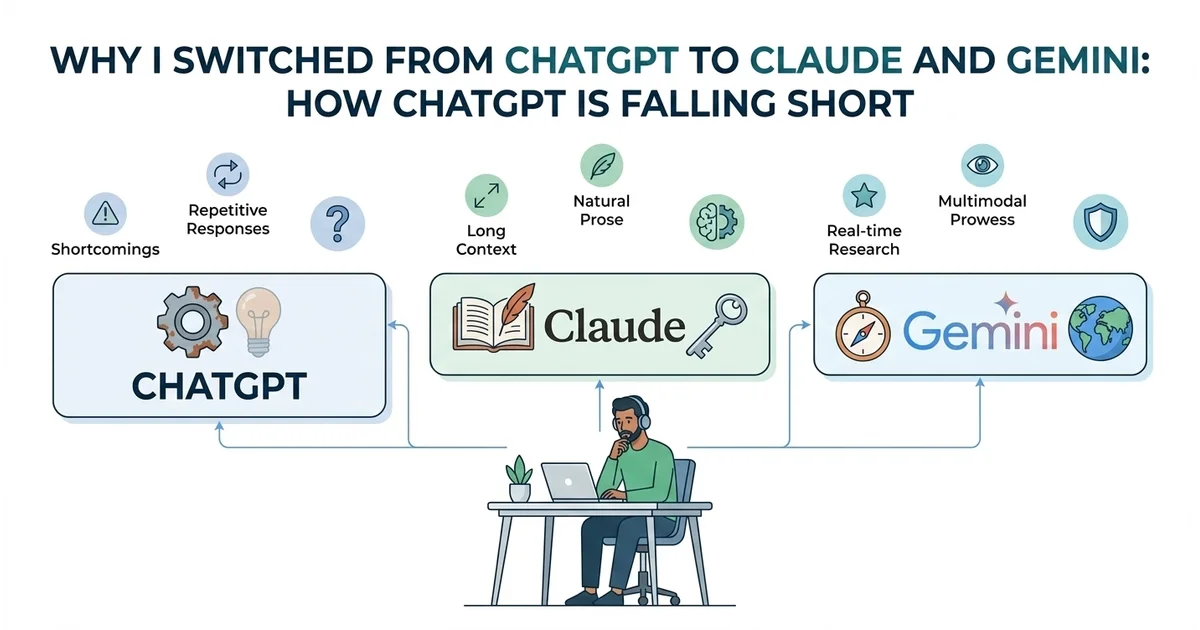
Why I Switched from ChatGPT to Claude and Gemini: How ChatGPT is Falling Short
Why I Switched from ChatGPT to Claude & Gemini:
Over the last few months, that superpower started feeling less like a sleek jetpack and more like a sputtering engine. I found myself spending more time correcting its output than using it. The responses became repetitive, the fact-checking became arduous, and the “creativity” felt increasingly formulaic.
I wasn’t alone in this frustration. The AI landscape has matured rapidly, and two primary contenders—Anthropic’s Claude and Google’s Gemini—have emerged not just as alternatives, but as superior tools for many sophisticated tasks.
This is the detailed account of why I finally, and permanently, switched from ChatGPT to a workflow split between Claude and Gemini, and precisely where ChatGPT is now falling short.
Why I Switched from ChatGPT to Claude & Gemini: The Cracks in the Crown: Where ChatGPT is Failing Short
ChatGPT (specifically the GPT-4 and GPT-4o models) is still a powerful tool, but its weaknesses are becoming impossible to ignore for power users. My decision to switch was driven by three primary recurring issues.
1. The Proliferation of “AI Hallucinations” and Factual Errors
The single most frustrating aspect of ChatGPT’s recent performance is its declining reliability. When GPT-4 was first released, it felt substantially more accurate than its predecessor. Recently, however, it seems to have regressed.
ChatGPT frequently generates confident, plausible-sounding answers that are factually incorrect. This is known as “hallucination.” For a researcher or writer, this is fatal. If I cannot trust the foundational facts the AI provides, the tool becomes a liability, not an asset.
When tasked with summarizing recent news or finding specific data points, ChatGPT often provides outdated information or completely invents statistics, citing non-existent sources with alarming confidence. This problem is exacerbated when dealing with niche topics or complex, multi-step reasoning.
2. Stagnant Context Windows and “Memory Loss”
The “context window” refers to how much text the AI can consider at one time (both your prompt and its previous responses). ChatGPT’s effective context window, especially in practical use, feels increasingly constrained.
When working on long-form content—like a 2,000-word eBook chapter or a detailed technical manual—ChatGPT quickly “forgets” instructions from the beginning of the conversation. I found myself constantly needing to re-prompt it with the initial style guide or central thesis, which defeats the purpose of a continuous conversational interface. The “memory” feature, while a step in the right direction, is often clumsy and inconsistent in its application.
3. Repetitive Output and a Formulaic “Voice”
There is a distinct “ChatGPT voice.” It loves transition words like “Furthermore,” “Moreover,” and “In conclusion.” It tends to structure every argument in a very predictable “Pros and Cons” list format. While initially polite, this style now feels sterile and uninspired.
For a content writer, this predictability is a major drawback. Achieving a unique, conversational, or highly technical tone requires immense effort in prompting, and the model frequently drifts back to its default, recognizable style. Its creativity seems to have plateaued; it’s excellent at summarizing the average, but struggles to generate truly novel or distinct prose.
4. The Performance Slump: Speed vs. Quality
With the introduction of GPT-4o (“o” for omni), OpenAI prioritized speed and multimodal capabilities. While GPT-4o is incredibly fast, many users, myself included, have noted a perceived drop in reasoning depth and response quality compared to the “classic” GPT-4.
It feels like OpenAI is trying to serve two masters: those who need instant, simple answers, and power users who need deep reasoning. In attempting both, the quality of the latter has suffered. The model often gives superficial answers to complex prompts, requiring multiple follow-ups to get the desired depth.
Why I Switched from ChatGPT to Claude & Gemini: Enter the Challengers: Why I Switched
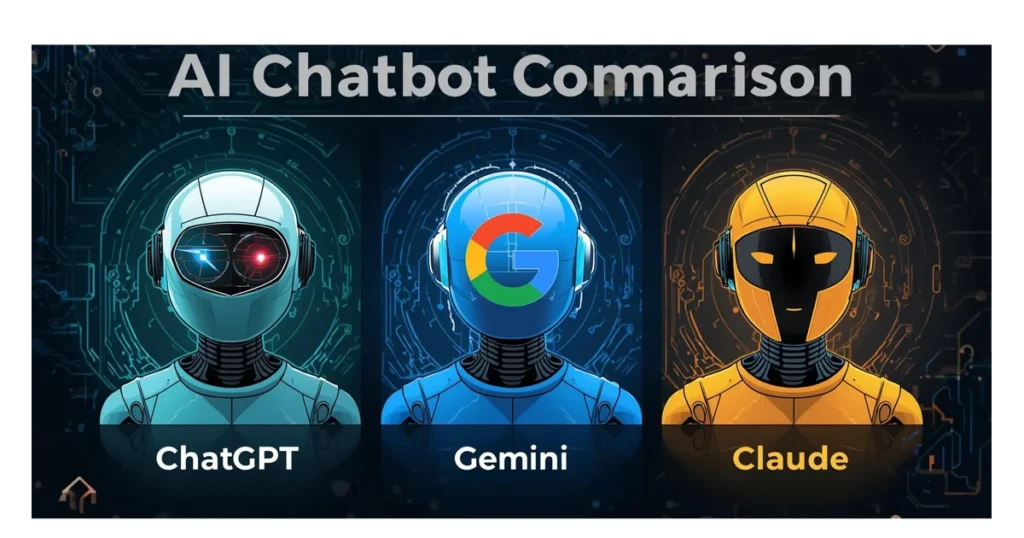
My move away from ChatGPT wasn’t just about its failures; it was about the tangible, superior capabilities of Claude and Gemini. I didn’t replace ChatGPT with one tool; I replaced it with two, each specializing in what ChatGPT now lacks.
Claude: The Superior Writer and Ethical Powerhouse
Developed by Anthropic, Claude (specifically the Claude 3 Opus and 3.5 Sonnet models) has become my primary tool for generating written content and complex reasoning.
The Context Window Game-Changer:
Claude’s defining feature is its massive context window (200,000 tokens). This is not just a statistical advantage; it’s a functional revolution. I can upload an entire 50-page PDF report, a complete book manuscript, or hours of interview transcripts, and Claude can analyze, summarize, or rewrite content based on the entire document without forgetting the context.
Natural, Human-Like Prose:
Claude’s writing style is significantly less formulaic than ChatGPT’s. It excels at adopting specific personas and tones. If I ask Claude to write a blog post in a “witty, conversational tone” or a “formal, academic style,” the resulting output requires far less editing. It naturally avoids the repetitive transitional clichés that plague ChatGPT.
Superior Nuance and Reasoning:
Claude 3.5 Sonnet, in particular, has demonstrated reasoning capabilities that frequently outperform GPT-4o. It is better at following complex, multi-part instructions and recognizing nuance in creative writing or ethical dilemmas. It hallucinates significantly less and is more likely to admit when it doesn’t know an answer, rather than inventing one.
Google’s Gemini: The Real-Time Researcher and Ecosystem King
While Claude handles the writing, Google’s Gemini (formerly Bard) has taken over all my research-intensive tasks.
Integration with Real-Time Google Data:
This is Gemini’s superpower. Gemini is deeply integrated with Google Search. When I ask for the current stock price of a company, recent geopolitical events, or the latest scientific breakthroughs, Gemini accesses real-time information. ChatGPT’s browsing feature is often slow, unreliable, and frequently fails to access current data. Gemini is seamless.
Multimodal Prowess and the Google Ecosystem:
Gemini is natively multimodal, meaning it was trained on text, images, code, and audio simultaneously. This makes its analysis of images and charts far more sophisticated. Furthermore, its integration with the Google Workspace ecosystem (Docs, Gmail, Drive) allows me to summarize emails or draft documents directly into Google Docs, creating an incredibly efficient workflow.
By the Numbers: Performance Comparison
To ground this switch in factual data, let’s compare the key metrics that matter most to performance users.
Table 1: Key Specifications Comparison
| Feature | ChatGPT (GPT-4o) | Claude (3.5 Sonnet) | Gemini (1.5 Pro) |
| Primary Strength | Speed, General Assistance | Writing Quality, Deep Reasoning | Real-Time Research, Ecosystem |
| Context Window | ~128k Tokens (Practical limit feels lower) | 200k Tokens (Robust and effective) | 1M+ Tokens (Industry Leading) |
| Writing Style | Formulaic, Predictable | Natural, Adaptable | Varies, Good with Real-Time Context |
| Real-Time Access | Clunky, Browse with Bing | No Native Browsing (relies on uploaded data) | Native, Seamless Google Search |
| Hallucination Rate | Perceived to be Increasing | Low, Admits Ignorance | Moderate (improving with Grounding) |
Hallucination and Accuracy Benchmarks
While specific, independent, continuously updated hallucination trackers are hard to finalize, recent independent analysis, such as that conducted by Vectara, has consistently placed Anthropic’s models as having some of the lowest hallucination rates in the industry when summarizing documents. Gemini has also shown significant improvement in this area, particularly when its answers are grounded by Google Search results.
(Reference: Independent analysis on model hallucination rates, e.g., Vectara’s Hughes Hallucination Evaluation Model leaderboard.)
People Also Ask (PAA)
To make this guide as comprehensive as possible, I’ve addressed the most common questions from users considering a similar switch.
Is Claude better than ChatGPT for writing?
Yes, for most long-form and creative writing tasks, Claude (specifically 3 Opus or 3.5 Sonnet) is superior. It possesses a more natural, human-like cadence, avoids formulaic transitions, and can handle a vastly larger context window, allowing it to maintain style and character consistency over much longer texts.
Does Gemini have real-time information?
Yes. Gemini is natively integrated with Google Search, providing seamless access to real-time information, news, and data. This makes it significantly more effective than ChatGPT for tasks requiring up-to-the-minute accuracy, such as market analysis or current events research.
Is ChatGPT still worth it?
ChatGPT is still a powerful general-purpose tool. Its strengths are its massive library of custom GPTs, its voice conversation mode (which is arguably the best), and its high-speed responses for simple tasks. For many casual users, it remains sufficient. However, for users requiring high factual accuracy, deep reasoning, or natural writing, Claude and Gemini currently offer better value.
Why I Switched from ChatGPT to Claude and Gemini: How ChatGPT is Falling Short
The era of ChatGPT’s unchallenged dominance is over. While it remains a significant and capable tool, its recent performance slump—characterized by increased hallucinations, repetitive output, and stagnant context handling—has created an opening for specialized, more powerful alternatives.
My workflow is now split, maximizing the strengths of the new leaders:
- I use Claude for writing and reasoning. Its superior prose, adaptable tone, and 200k context window make it the ultimate tool for drafting, editing, and analyzing long documents.
- I use Gemini for research and real-time data. Its native integration with Google Search and Multimodal capabilities make it the best choice for accurate, up-to-date information gathering.
I have not “quit” AI; I have upgraded my toolkit. For anyone who uses AI for serious professional or creative work, the limitations of ChatGPT are likely holding you back. It’s time to explore the specialized power of Claude and Gemini.
References
- Anthropic. (2024). Introducing the Claude 3 Model Family. Anthropic. [Online] Available at: anthropic.com
- Google DeepMind. (2024). Gemini 1.5: Our next-generation multimodal model. Google. [Online] Available at: deepmind.google
- Vectara. (2024). Hughes Hallucination Evaluation Model (HEM) Leaderboard. Vectara. [Online] Available at: https://www.google.com/search?q=vectara.com