
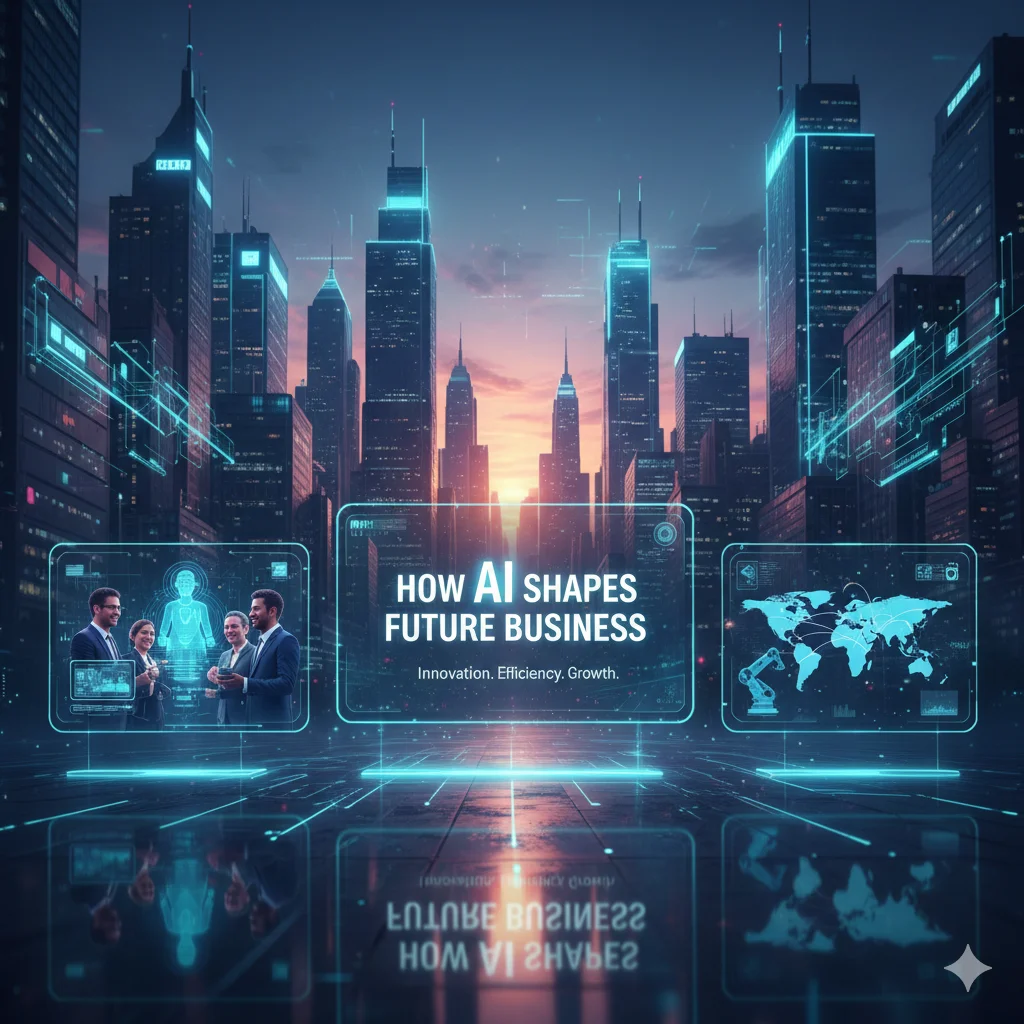
How AI is future of Business
In today’s fast-moving digital world, it’s clear that artificial intelligence (AI) is no longer just a futuristic buzzword — it’s rapidly becoming a core driver of business transformation. From improving operational efficiency to creating entirely new business models, AI offers a strategic edge for companies willing to embrace it. In this blog, we’ll explore how AI is shaping the future of business, why it matters, the key areas of impact, the challenges companies face, and how any business (large or small) can prepare to ride this wave successfully.
Why AI Isn’t Optional — It’s Imperative
First, let’s establish why AI must be part of any serious business strategy going forward.
- Competitive pressures: As outlined by recent analyses, companies embedding AI into their core operations are starting to see measurable advantages in cost, speed, and innovation.
- Changing customer expectations: Today’s customers expect personalized experiences, rapid responses, and seamless digital interactions — all areas where AI excels.
- Scale & data enablement: Business data volumes are exploding. AI enables companies to convert raw data into insights, automate complex decisions, and scale operations in ways humans alone cannot. Innovation & new business models: Beyond incremental improvement, AI is enabling firms to rethink how they deliver value — designing smarter services, predictive systems, and new revenue streams.
Key Areas Where AI is Driving Business Futures
Here are the main functional areas in which AI is having major impact — and why they matter.
1. Automation & Operational Efficiency
One of the most immediate benefits of AI is automating routine, repetitive tasks so that humans can focus on higher-value work.
Examples include:
- Data-entry and transaction processing handled by bots
- Automated customer service via chatbots and virtual assistants
- Predictive maintenance in manufacturing using sensor data
By automating tasks, businesses reduce costs, minimize errors and increase speed — all critical for staying competitive.
2. Enhanced Decision-Making & Predictive Intelligence
AI excels at ingesting massive amounts of data, spotting patterns, forecasting trends, and supporting decision-making.
For instance:
- Supply-chain forecasting: anticipating demand and adjusting inventory.
- Marketing optimization: real-time insights on customer segments and campaign performance.
- Strategic planning: AI-driven scenario modelling to guide investments and resource allocation.
Companies that use AI in decision-making are better positioned to respond to change rather than simply react.
How AI is future of Business 3. Personalization & Customer Experience :
In the future of business, ‘one-size-fits-all’ is being replaced by hyper-personalized user experiences, powered by AI.
Examples:
- E-commerce platforms recommending products based on past behaviour and current context.
- AI chatbots offering 24/7 support, tailored to the customer’s profile and history.
- Smart marketing automation that adapts message content, channel and timing based on real-time analytics.
Better customer experience → higher loyalty → stronger brand and revenue.
4. New Business Models & Innovation
AI isn’t just about doing old things faster — it’s about doing new things
Consider:
- Using generative AI (text, image, video) to create content or prototypes faster.
- Subscription or usage-based models enabled by real-time insights and automation.
- Edge AI + IoT enabling smart products and services (for example, connected appliances that anticipate needs).
When businesses adopt AI-driven models early, they open up entirely new markets and revenue streams.
5. Workforce Evolution & Skills
AI changes how work gets done, and this has major implications for talent, upskilling and organisational structure.
Key themes:
- Employees will increasingly collaborate with AI agents/assistants.
- AI literacy becomes a baseline skill.
- Roles shift from routine execution to oversight, creativity and human judgement.
Businesses that invest in workforce transformation will be better prepared for the future.
Real-World Outlook: What the Data Say
Understanding what’s happening on the ground helps clarify why this matters.
- According to sources, by 2026 many organisations expect major portions of customer-facing processes to be automated via multi-agent AI.
- Research shows that AI adoption is already widespread: over 78% of organisations are using or exploring AI.
- For Small and Medium-sized Enterprises (SMEs), AI is no longer just for big firms — it’s becoming accessible and strategic.
These data points mean: It’s not just the ‘big tech’ companies — every business must evaluate how AI fits into their future.
Challenges & Considerations: It’s Not Plug-and-Play
Despite the promise, adopting AI is not without its hurdles. Businesses must navigate these to truly succeed.
- Data quality and infrastructure: AI works when data is clean, accessible and reliable. Many organisations struggle with legacy systems or fragmented data.
- Skills and culture gaps: Employees may resist change, or lack the skills needed to integrate AI into workflows. Investing in training and change-management is critical.
- Ethics, regulation & trust: As AI takes bigger roles in decision-making, concerns around bias, transparency, governance and accountability become important.
- Choosing the right use-cases: Not all tasks or processes benefit equally from AI. Picking low-hanging fruit and building from success matters.
- Integration vs Islands: Many firms adopt point-solutions, but the real value lies in embedding AI into end-to-end workflows and business models.
Ignoring these risks isn’t an option — because the cost of falling behind could mean losing competitive relevance.
What the Future Might Look Like
Peering ahead, here are some of the expected developments in the next few years:

- AI agents will become more autonomous, handling entire workflows with minimal human input. Many customer-facing or B2B processes may be mediated end to end by AI.
- The convergence of AI + IoT + edge computing will push intelligence closer to where data is generated (factories, vehicles, retail terminals).
- Human roles will shift: from doing tasks to “bossing” AI systems — defining problems, interpreting results, managing exceptions.
- Businesses will be judged not just on features or products — but on how intelligently they can adapt, respond, personalize, and scale using AI.
- Firms that ignore AI may find themselves structurally disadvantaged — higher costs, slower responses, lower customer gratification.
Innovation Acceleration
AI accelerates research and development processes by rapidly testing hypotheses, simulating scenarios, and identifying promising avenues for innovation. Pharmaceutical companies use AI to discover new drug candidates, while product designers leverage AI to create and test prototypes virtually before physical production.
AI Technologies Shaping Business Future
| AI Technology | Business Application | Expected Impact by 2030 |
| Machine Learning | Predictive analytics, pattern recognition | 45% productivity increase |
| Natural Language Processing | Customer service, content creation | 60% cost reduction in support |
| Computer Vision | Quality control, security systems | 35% defect reduction |
| Robotic Process Automation | Administrative tasks, data processing | 70% efficiency improvement |
People Also Ask
Will AI replace human jobs in business?
AI will makes jobs easier rather than eliminate.. While AI automates repetitive tasks, it creates new roles in AI management, data science, and strategic planning. The key is workforce adaptation through continuous learning and skill development.
What is the cost to implement AI in a business?
Implementation costs vary widely based on company size and complexity. Small businesses can start with affordable cloud-based AI tools for a few hundred dollars monthly, while enterprise solutions may require six or seven-figure investments. However, ROI typically justifies the initial expenditure within 12-24 months.
What industries benefit most from AI?
Healthcare, finance, retail, manufacturing, and logistics see particularly dramatic benefits from AI. However, virtually every industry can leverage AI for improved decision-making, customer service, and operational efficiency.
Is AI technology reliable for critical business decisions?
AI reliability depends on data quality and proper implementation. When designed correctly, AI systems make highly accurate predictions and recommendations. However, human oversight remains essential for critical decisions, with AI serving as a powerful decision-support tool rather than a replacement for human judgment.
References:
- McKinsey & Company. “The State of AI in 2024.” McKinsey Global Institute.
- World Economic Forum. “Future of Jobs Report 2025.”
- Salesforce. “State of Service Report.” Salesforce Research, 2025.

One Comment on “How AI is future of Business”