
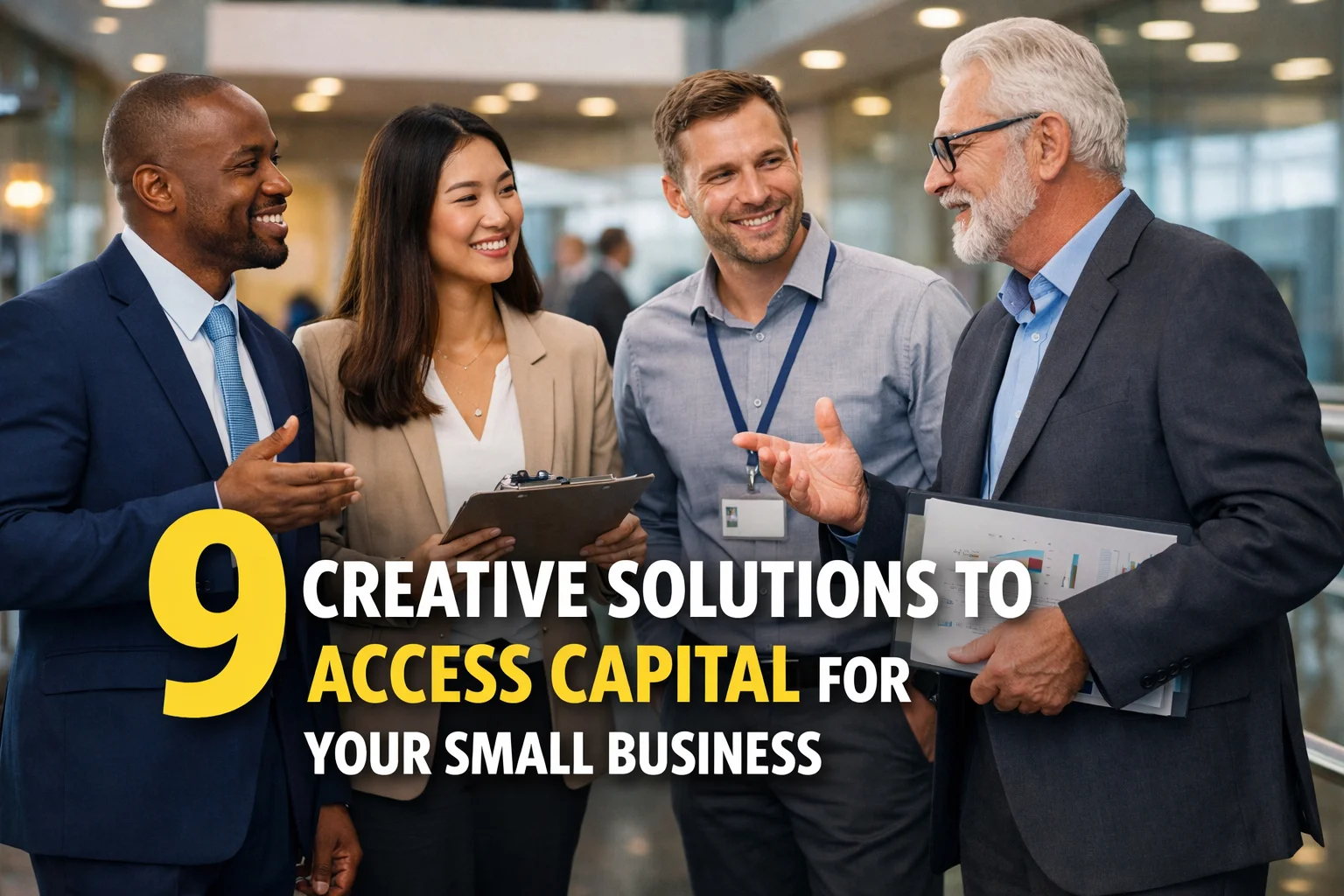
9 Creative Solutions to Access Capital for Your Small Business
In 2026, the traditional small business loan—once the bedrock of entrepreneurship—has become more of a secondary option. With high-interest rates and rigid credit requirements still dominating the banking sector, modern business owners are turning toward “alternative capital” to fuel their dreams.
Accessing capital is no longer just about filling out a loan application; it’s about choosing a financial vehicle that aligns with your business model, your growth stage, and your community. If you’re looking to scale without the headache of a traditional bank, here are 9 creative solutions to access capital for your small business in today’s economy.
9 Creative Solutions to Access Capital for Your Small Business
1. Revenue-Based Financing (RBF)
Revenue-based financing is arguably the most “entrepreneur-friendly” model of the decade. Instead of a fixed monthly payment, you receive a lump sum of capital and pay it back as a small percentage of your daily or monthly sales.
- How it Works: If you have a $10,000 month, you might pay back $500. If you have a slow $2,000 month, you only pay $100.
- Best For: Companies with high gross margins or recurring revenue (like SaaS or e-commerce) that need growth capital but want to protect their cash flow during seasonal dips.
- The Benefit: There is no fixed “due date” for the loan; the repayment naturally adjusts to your success.
2. Equity Crowdfunding
Unlike platforms where you give away t-shirts or early products (like Kickstarter), Equity Crowdfunding allows you to sell actual shares of your company to the general public.
- How it Works: You list your business on a regulated platform, and hundreds—or thousands—of everyday people can invest as little as $100.
- Best For: Brands with a cult following or a strong “social proof” element. It turns your customers into your most vocal shareholders.
- The Benefit: You don’t just get capital; you get an army of brand ambassadors who are financially incentivized to see your business grow.
3. Invoice Factoring & Receivables Financing
If your business is struggling because you’re waiting 60 or 90 days for clients to pay their bills, you don’t have a “profit” problem—you have a “liquidity” problem. Invoice Factoring fixes this.
- How it Works: You sell your outstanding invoices to a factoring company at a small discount (usually 1-3%). They give you the cash immediately and then collect the full amount from your client later.
- Best For: B2B companies, manufacturing, or service providers with long payment cycles.
- The Benefit: It isn’t debt; it’s just getting your own money faster.
4. Community Development Financial Institutions (CDFIs)
CDFIs are mission-driven lenders (often nonprofits or community banks) that receive federal funding to support businesses in underserved areas or those run by minority, veteran, or women entrepreneurs.
- How it Works: CDFIs look beyond the “FICO score.” They prioritize the impact your business has on the local community, such as job creation or providing essential services.
- Best For: Local brick-and-mortar shops and startups that may have been rejected by big banks.
- The Benefit: They often provide free business coaching and mentorship alongside the capital.
5. Strategic Partnership Funding
Sometimes the best “investor” is a future business partner. Large corporations often have “innovation funds” meant to support smaller companies that can help their own supply chain.
- How it Works: A larger company in your industry provides you with capital in exchange for exclusive distribution rights, a first-look at your technology, or a minority stake.
- Best For: Tech startups or specialized manufacturers who solve a specific problem for a larger industry player.
- The Benefit: You gain instant credibility and access to the partner’s vast network.
6. Equipment Leasing & Asset-Based Lending

Why spend $50,000 upfront on a piece of machinery when you can lease it? Asset-based lending allows you to use your physical assets as collateral for a line of credit.
- How it Works: The equipment itself serves as the security for the loan. If you stop paying, the lender takes the equipment back. This makes it much easier to get approved than a general business loan.
- Best For: Restaurants, medical practices, and construction firms with heavy hardware needs.
- The Benefit: It preserves your cash for other needs like marketing or payroll.
7. Founding Member Pre-Sales
This is “Internal Crowdfunding.” Before you launch a new product or service, you offer a “Founder’s Tier” or a “Lifetime Membership” to your most loyal customers.
- How it Works: You sell a limited number of high-value packages at a discount. For example, a new gym might sell 50 “Lifetime Memberships” for $2,000 each to fund their build-out.
- Best For: Service-based businesses, local boutiques, or software launches.
- The Benefit: It’s 100% interest-free capital that also validates your product idea.
8. Peer-to-Peer (P2P) Lending
P2P lending skips the bank entirely. Online platforms match business owners directly with individual investors looking to earn a higher interest rate than they would in a savings account.
- How it Works: You post your loan request on a P2P platform. Multiple investors “bid” on parts of your loan until it’s fully funded.
- Best For: Established businesses with a solid track record but who want more competitive rates than traditional lenders offer.
- The Benefit: The process is typically much faster and more transparent than a bank application.
9. Supply Chain Financing (Trade Credit)
Your suppliers can be your biggest financiers. By negotiating Net-60 or Net-90 payment terms, you are essentially getting an interest-free loan for the duration of that period.
- How it Works: Instead of paying for inventory the day it arrives, you negotiate to pay 60 days later. This allows you to sell the product before you’ve actually paid for it.
- Best For: Retailers and wholesalers.
- The Benefit: It scales perfectly with your growth. As you buy more inventory, your “credit line” from the supplier naturally increases.
Comparison of Solutions
| Solution | Cost of Capital | Speed | Ownership Impact |
| Revenue-Based | Moderate | Fast | None |
| Equity Crowdfund | Low (Upfront) | Slow | Diluted |
| Invoice Factoring | Moderate | Very Fast | None |
| CDFI Loans | Low | Moderate | None |
| Equipment Lease | Low/Moderate | Fast | None |
9 Creative Solutions to Access Capital for Your Small Business: People Also Ask (FAQ)
What is the easiest way to get capital for a new small business?
For brand-new businesses, Founding Member Pre-Sales and CDFIs are usually the most accessible. Pre-sales require no credit check, and CDFIs are specifically designed to help those who are often ignored by traditional banks.
Can I get business funding without a personal guarantee?
Yes. Revenue-Based Financing and Invoice Factoring often do not require a personal guarantee because the “collateral” is the business’s future revenue or unpaid invoices rather than your personal home or car.
Is crowdfunding better than a bank loan?
Crowdfunding is better if you have a strong community and want to avoid debt. However, it requires a lot of marketing effort. A bank loan is better if you have a great credit score and want a predictable, fixed interest rate.
How do I prepare for an alternative funding application?
Lenders in 2026 are looking for clean books. Ensure your accounting software (like QuickBooks or Xero) is up to date and that you can show a clear “cash flow forecast” for the next 12 months.
Finding Your Financial Fit
Capital is the fuel for your business, but choosing the wrong “grade” can stall your engine. Before committing, ask yourself: Am I willing to give up equity, or do I prefer to manage debt?
In 2026, the power has shifted back to the entrepreneur. By leveraging these nine creative solutions, you can find the funding you need on your own terms.


2 Comments on “9 Creative Solutions to Access Capital for Your Small Business”