The 25 Best Franchise Businesses in the USA for 2026
Choosing to invest in a franchise is one of the most significant financial decisions an entrepreneur can make. In 2026, the American franchise landscape is more diverse than ever, blending high-tech automation with “recession-proof” essential services. With the U.S. franchise output projected to grow by over 4% this year, the opportunities are vast, but the challenge lies in selecting a brand that offers both a proven track record and future-ready scalability.
Whether you are looking for a low-cost home-based venture or a high-revenue brick-and-mortar powerhouse, these 25 franchise businesses represent the “gold standard” of reliability and profitability in the current market.
The 25 Best Franchise Businesses in the USA for 2026
1. The UPS Store
- Initial Investment: $138,000 – $567,000
- Why it’s a winner: High brand recognition and a vital role in the “last-mile” delivery economy.
2. Chick-fil-A
With the highest Average Unit Volume (AUV) in the fast-food industry—averaging over $7.5 million per location—Chick-fil-A remains the most coveted franchise in America.
- Initial Investment: $10,000 (Low entry fee, but highly selective).
- Why it’s a winner: Unmatched customer loyalty and a highly efficient operational model.
3. SERVPRO
In the home services sector, SERVPRO is the leader in fire and water restoration. As climate-related property damage becomes more frequent, this “essential service” continues to see massive demand.
- Initial Investment: $160,000 – $240,000
- Why it’s a winner: It is one of the most recession-resistant models available today.
4. Planet Fitness
Health and wellness are booming in 2026. Planet Fitness dominates the “high-volume, low-cost” gym model, appealing to the 80% of the population that isn’t looking for a hardcore bodybuilding environment.
- Initial Investment: $1.1M – $5M
- Why it’s a winner: Strong recurring revenue through membership dues and a “judgment-free” brand that attracts a massive demographic.
5. 7-Eleven
As the world’s largest convenience retailer, 7-Eleven is a staple of American life. Their 2026 model focuses heavily on fresh food and digital delivery integration.
- Initial Investment: $100,000 – $1.2M
- Why it’s a winner: High-traffic locations and a turnkey system that is easy to replicate.
6. Jersey Mike’s Subs
The sandwich segment is seeing a “quality over quantity” shift. Jersey Mike’s has outperformed competitors by focusing on fresh-sliced meats and premium branding.
- Initial Investment: $190,000 – $800,000
- Why it’s a winner: One of the fastest-growing QSR (Quick Service Restaurant) brands with excellent franchisee support.
7. Anytime Fitness
Unlike big-box gyms, Anytime Fitness offers a 24/7 “boutique” feel with a smaller footprint. This allows for lower real estate costs and higher penetration in suburban markets.
- Initial Investment: $300,000 – $600,000
- Why it’s a winner: Global brand presence and a semi-absentee ownership model.
8. Jan-Pro
If you are looking for a low-cost entry point, Jan-Pro is a leader in commercial cleaning. They provide a “guaranteed customer base” model that helps new owners hit the ground running.
- Initial Investment: $4,000 – $50,000
- Why it’s a winner: Low overhead and a focus on B2B contracts which offer stability.
9. Culver’s
A Midwest powerhouse that has successfully expanded nationwide. Known for “ButterBurgers” and frozen custard, Culver’s boasts a loyal fan base and strong per-unit profitability.
- Initial Investment: $2.5M – $5M
- Why it’s a winner: Superior product quality and a family-oriented culture that reduces staff turnover.
10. Domino’s
Domino’s isn’t just a pizza company; in 2026, it is a tech company that sells pizza. Their delivery logistics and AI-driven ordering systems make them the most efficient player in the game.
- Initial Investment: $119,000 – $460,000
- Why it’s a winner: Dominant market share in delivery and a relatively low entry cost compared to other major food brands.
11. Cruise Planners
A premier home-based franchise. As the travel industry reaches record highs in 2026, Cruise Planners allows you to run a full-scale travel agency from a laptop.
- Initial Investment: $2,000 – $23,000
- Why it’s a winner: Extremely low overhead and no inventory requirements.
12. Taco Bell
Taco Bell continues to lead the Mexican QSR category by constantly innovating its menu and store formats (like the “Defy” drive-thru models).
- Initial Investment: $500,000 – $3.5M
- Why it’s a winner: High margins and a brand that resonates deeply with younger demographics.
13. Merry Maids
With dual-income households at an all-time high, residential cleaning is no longer a luxury—it’s a necessity. Merry Maids is the most recognized name in the sector.
- Initial Investment: $95,000 – $145,000
- Why it’s a winner: Recurring revenue and a simple, scalable operational playbook.
14. Kumon Math & Reading Centers
Education is a top priority for American parents. Kumon’s after-school enrichment program is a global leader with a proven curriculum that spans decades.
- Initial Investment: $65,000 – $140,000
- Why it’s a winner: Low staffing requirements and a mission-driven business model.
15. Dunkin’
Dunkin’ has successfully transitioned from a “donut shop” to a beverage-led brand. Coffee has higher margins than food, making this a very attractive investment.
- Initial Investment: $500,000 – $1.8M
- Why it’s a winner: Morning routine loyalty ensures consistent daily cash flow.
16. Right at Home (Senior Care)
10,000 people turn 65 every day in the U.S. Right at Home provides in-home care and assistance, tapping into the massive “silver tsunami” of the aging population.
- Initial Investment: $80,000 – $150,000
- Why it’s a winner: Huge demographic tailwinds and an emotionally rewarding business.
17. Budget Blinds
A leader in the home improvement niche. Budget Blinds operates on a “mobile showroom” model, meaning you don’t need expensive retail space.
- Initial Investment: $125,000 – $200,000
- Why it’s a winner: High-ticket items with professional corporate support for leads.
18. Ace Hardware
Unlike the big-box “orange” or “blue” stores, Ace Hardware focuses on being the “helpful neighborhood” shop. It is a cooperative, meaning owners have more say in their business.
- Initial Investment: $300,000 – $2M
- Why it’s a winner: Essential retail status and a “recession-proof” DIY customer base.
19. SuperGlass Windshield Repair
A high-margin mobile service. As vehicle prices soar, people are choosing to repair rather than replace, making windshield repair a booming niche.
- Initial Investment: $20,000 – $85,000
- Why it’s a winner: Low entry cost and mobile flexibility.
20. Wingstop
Wingstop has perfected the “small footprint” model. Most of their business is carry-out or delivery, which significantly reduces labor and real estate costs.
- Initial Investment: $300,000 – $900,000
- Why it’s a winner: Extremely high ROI per square foot.
21. Matco Tools
A “business on wheels” franchise. You sell professional-grade tools directly to mechanics at their place of work.
- Initial Investment: $100,000 – $300,000
- Why it’s a winner: No rent, no utilities, and a built-in customer base of automotive professionals.
22. Sport Clips
The “men’s grooming” niche is one of the most stable in the beauty industry. Sport Clips offers a unique “MVP” experience that keeps clients coming back every 3-4 weeks.
- Initial Investment: $260,000 – $400,000
- Why it’s a winner: High frequency of repeat business and a semi-absentee model.
23. Orangetheory Fitness
Orangetheory pioneered “science-backed” group fitness. In 2026, their use of wearable tech and community-based motivation makes them a leader in the boutique fitness space.
- Initial Investment: $600,000 – $1M
- Why it’s a winner: High member retention and premium pricing power.
24. Kona Ice
One of the highest-rated franchises for “owner satisfaction.” These colorful shaved-ice trucks are staples at community events, schools, and fairs.
- Initial Investment: $150,000 – $200,000
- Why it’s a winner: Low labor, high margins, and a “fun” business environment.
25. European Wax Center
The hair removal industry is a multi-billion dollar market. European Wax Center has modernized the experience with a sleek, clinical, yet high-end feel.
- Initial Investment: $350,000 – $600,000
- Why it’s a winner: High recurring revenue through their “Wax Pass” membership model.
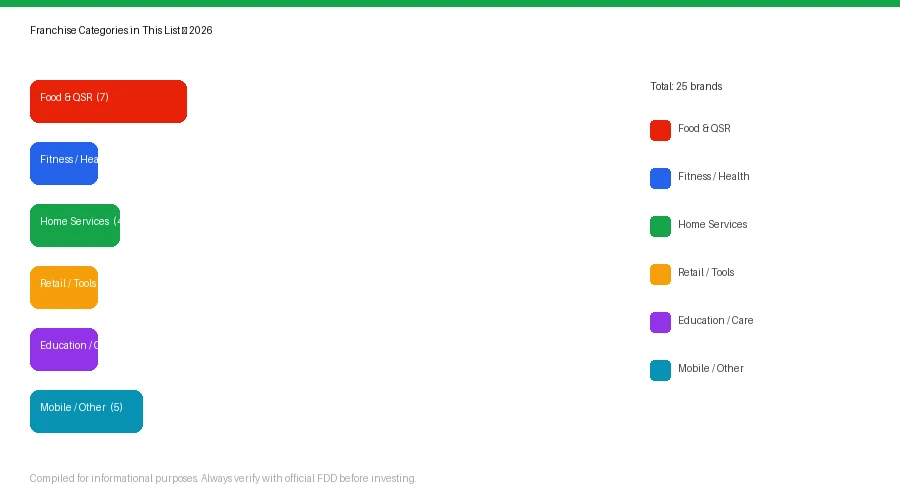
Investment at a Glance — All 25 Franchises
Investment ranges sourced from Franchise Disclosure Documents (FDDs) and Entrepreneur Franchise 500, 2026.
| # | Franchise | Min. Investment | Max. Investment | Category |
| 11 | Cruise Planners | $2,000 | $23,000 | Home-Based / Travel |
| 8 | Jan-Pro | $4,000 | $50,000 | Commercial Cleaning |
| 19 | SuperGlass Windshield | $20,000 | $85,000 | Automotive Mobile |
| 14 | Kumon Centers | $65,000 | $140,000 | Education |
| 16 | Right at Home | $80,000 | $150,000 | Senior Care |
| 13 | Merry Maids | $95,000 | $145,000 | Residential Cleaning |
| 5 | 7-Eleven | $100,000 | $1,200,000 | Convenience Retail |
| 21 | Matco Tools | $100,000 | $300,000 | Mobile Tools |
| 17 | Budget Blinds | $125,000 | $200,000 | Home Improvement |
| 1 | The UPS Store | $138,000 | $567,000 | Retail / B2B |
| 24 | Kona Ice | $150,000 | $200,000 | Mobile Food |
| 3 | SERVPRO | $160,000 | $240,000 | Restoration |
| 6 | Jersey Mike’s | $190,000 | $800,000 | QSR Food |
| 22 | Sport Clips | $260,000 | $400,000 | Men’s Grooming |
| 7 | Anytime Fitness | $300,000 | $600,000 | Fitness |
| 18 | Ace Hardware | $300,000 | $2,000,000 | Hardware Retail |
| 20 | Wingstop | $300,000 | $900,000 | QSR / Wings |
| 25 | European Wax Center | $350,000 | $600,000 | Beauty |
| 12 | Taco Bell | $500,000 | $3,500,000 | QSR / Mexican |
| 15 | Dunkin’ | $500,000 | $1,800,000 | Beverage / QSR |
| 23 | Orangetheory | $600,000 | $1,000,000 | Boutique Fitness |
| 4 | Planet Fitness | $1,100,000 | $5,000,000 | Fitness |
| 10 | Domino’s | $119,000 | $460,000 | Pizza / Delivery |
| 2 | Chick-fil-A | $10,000* | $10,000* | QSR |
| 9 | Culver’s | $2,500,000 | $5,000,000 | Fast Casual |
*Chick-fil-A’s $10,000 fee covers operator licensing only — the company owns the real estate and equipment. Total investment is far higher on their side. All figures sourced from published FDDs and Entrepreneur Franchise 500 (2026).
The 25 Best Franchise Businesses in the USA for 2026 : How to Choose the Right Franchise for You
Investing in a brand is only the first step. To ensure success in 2026, you must align your personal strengths with the brand’s requirements.
Consider the “Total Investment”
Beyond the franchise fee, you must account for real estate, equipment, and at least six months of working capital.
Evaluate the Support System
The best franchises offer robust training “universities,” national marketing funds, and field consultants who visit your location to help optimize operations.
Market Demand vs. Market Saturation
A great brand can fail in the wrong market. Conduct a thorough “Gap Analysis” in your local territory to see if the service is actually needed or if the competition is too high.
The 25 Best Franchise Businesses in the USA for 2026: People Also Ask (FAQ)
What is the most profitable franchise to own in 2026?
While “profitability” depends on management, Chick-fil-A consistently leads in revenue per unit. However, for the best Return on Investment (ROI) relative to startup costs, service-based franchises like SERVPRO or The UPS Store are top contenders.
Can I run a franchise part-time?
Yes, several models are designed for “semi-absentee” ownership, such as Sport Clips, Planet Fitness, and vending/laundry franchises. These allow you to keep your day job while a professional manager handles daily operations.
What is a Franchise Disclosure Document (FDD)?
The FDD is a legal document required by the FTC. It contains 23 items of information about the franchisor, including their financial health, litigation history, and the estimated costs you will incur.
Is it better to start a franchise or an independent business?
Franchises offer a higher success rate (approx. 90% after five years) because you are buying a proven system, brand recognition, and a support network. Independent businesses offer more creative freedom but carry higher risk.
How much do franchise owners actually make?
This varies enormously by brand, territory, and operator quality. The IFA estimates that the average franchise owner earns around $80,000 – $100,000 annually after expenses, but that median hides a wide range. High-performing operators of strong QSR brands can earn several hundred thousand dollars a year; home-based franchises typically generate more modest returns in exchange for lower investment and risk. Always review the FDD’s Item 19 for the specific brand you’re evaluating.
References & Sources
- International Franchise Association (IFA) — Franchise Business Economic Outlook 2026. franchise.org
- Entrepreneur Media — Franchise 500 Rankings 2026. entrepreneur.com/franchises/franchise500
- U.S. Federal Trade Commission (FTC) — Franchises: Buying a Franchise, A Consumer Guide. ftc.gov