SEO for Business Growth 2026: How Small Brands Build Their Way to Big Audiences
Most SEO articles sound like instruction manuals. This one tries to sound like a conversation — because growing a business through search is less about tactics and more about understanding what people actually need when they type something into Google.
There’s a version of SEO that feels like a game. Keywords, backlinks, meta tags — optimize enough boxes and you climb the rankings. That version isn’t wrong, exactly. But it misses something important: the reason search engines work the way they do is because they’re trying to answer real questions from real people. The businesses that grow through SEO are the ones that understand that first.
Here’s what the data says about where organic search actually sits in the marketing mix — and why it keeps outperforming other channels over time.
SEO for Business Growth 2026
Why SEO Is Really a Trust Problem
When someone searches for something, they’re not just looking for information. They’re implicitly asking: who should I trust on this? Google’s platform is to answer that query. Your SEO strategy, at its core, is about earning that trust — from both search engines and the actual humans reading your pages.
This reframe matters practically. It explains why thin content ranked with tricks eventually slides. It explains why a local plumber with 200 genuine five-star reviews can outrank a national chain with a polished website. And it explains why the fundamentals of SEO — good content, clear site structure, real authority — have stayed consistent even as algorithm updates have reshuffled everything else.
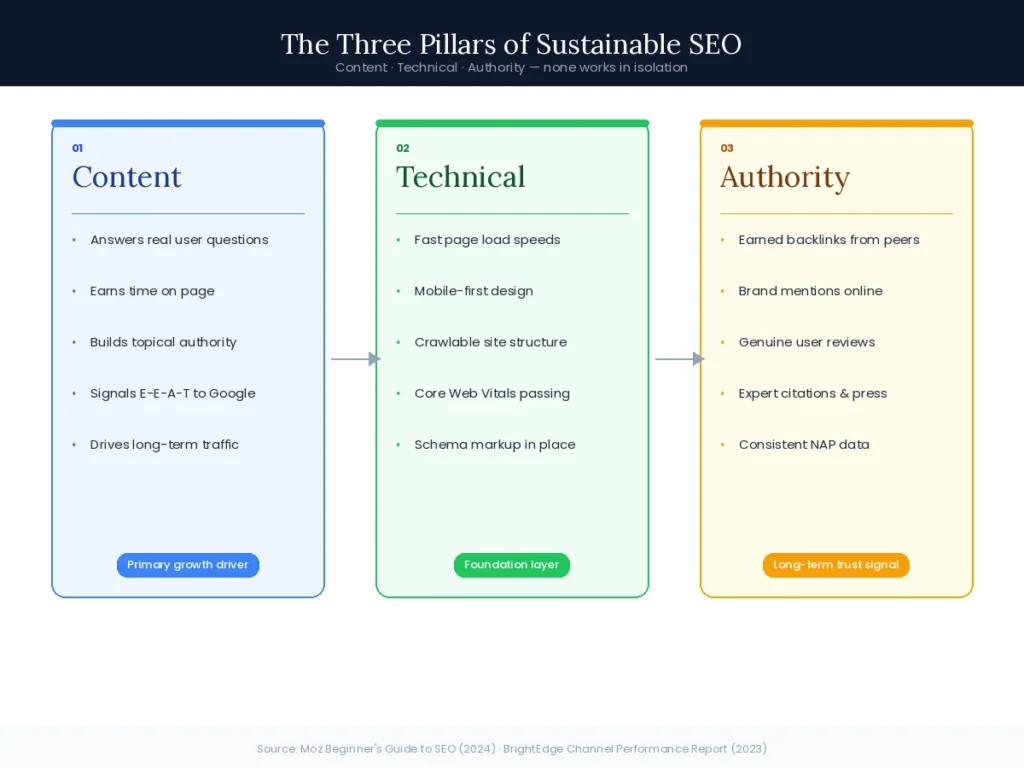
The SEO trust triangle — what builds lasting visibility Content Answers real questions Earns time-on-page Builds authority Signals expertise Primary driver Technical Fast page loads Mobile friendly Crawlable structure Clear page signals Foundation layer Authority Earned backlinks Brand mentions Reviews & ratings Expert citations Long-term signal All three reinforce each other. Weakness in one limits the other two.
The three pillars of sustainable SEO — none works in isolation
SEO for Business Growth 2026
The Growth Ladder: How SEO Scales With Your Business
One of the quieter advantages of SEO is that it doesn’t require a media budget to scale. A startup operating out of a spare bedroom can, with time and consistency, build organic visibility that outperforms a competitor spending thousands a month on ads. The mechanism is different — it’s cumulative rather than transactional — but that’s exactly what makes it durable.
The growth path typically looks like this: local foundation first, then regional expansion, then national or global reach.
| Stage | Focus | Typical timeframe | Key metric |
| Local | Google Business Profile, local keywords, reviews | 1–3 months to first traction | Local pack appearances |
| Regional | City/state pages, long-tail content, backlinks | 3–9 months | Organic sessions growth |
| National | Topic authority, pillar content, PR-driven links | 9–18 months | Domain authority + share of voice |
| Global | Hreflang, localised content, international link building | 18–36 months | Multi-market organic revenue |
A BrightEdge study found that organic search drives 53% of all website traffic — more than paid search, social, and email combined. The advantage compounds: pages that rank well continue generating traffic without ongoing spend. [2]
Starting Local: Why Your Neighborhood Is Your Best Proving Ground
There’s a temptation when you’re ambitious to skip the local phase and aim straight for national keywords. Resist it. Local search is where trust gets established cheapest and fastest, and where Google first learns to associate your domain with relevance.
Optimising your Google Business Profile takes about 30 minutes. Getting listed on a handful of local directories takes an afternoon. Responding thoughtfully to your first 20 reviews — even just acknowledging negative ones — builds the kind of credibility that takes paid ads months of spend to replicate.
What actually moves local rankings
Google’s local algorithm weighs three things heavily: relevance (does your listing match what was searched?), distance (how close are you to the searcher?), and prominence (how established is your business online?). Of those, prominence is the one you have the most control over — and it’s built through reviews, citations, and content.
Content That Earns Rankings vs Content That Just Exists
There’s a real difference between publishing content and publishing content that earns traffic. The distinction isn’t about length or SEO formatting — it’s about whether the piece actually helps someone. Google’s Helpful Content system, introduced in 2022 and refined since, specifically targets content created primarily for search engines rather than people. It’s gotten quite good at telling the difference.
The most reliable content strategy for a growing business is deceptively simple: answer the questions your customers actually ask. Not the questions you wish they’d ask. The ones they type at 11pm when they’re trying to figure out whether to hire you.
Keyword strategy evolves as your business grows Early stage”plumber near me””electrician in Austin”Growing stage”best plumber in Texas””electrical inspection cost”Scale stage”emergency plumbing guide””home electrical safety tips”High intentLow competitionBroader reachMedium competitionAuthority buildingCompounding trafficEach stage should include content targeting the previous stages too
The keyword expansion model — start specific, grow deliberately
SEO for Business Growth 2026:
What the Numbers Actually Look Like
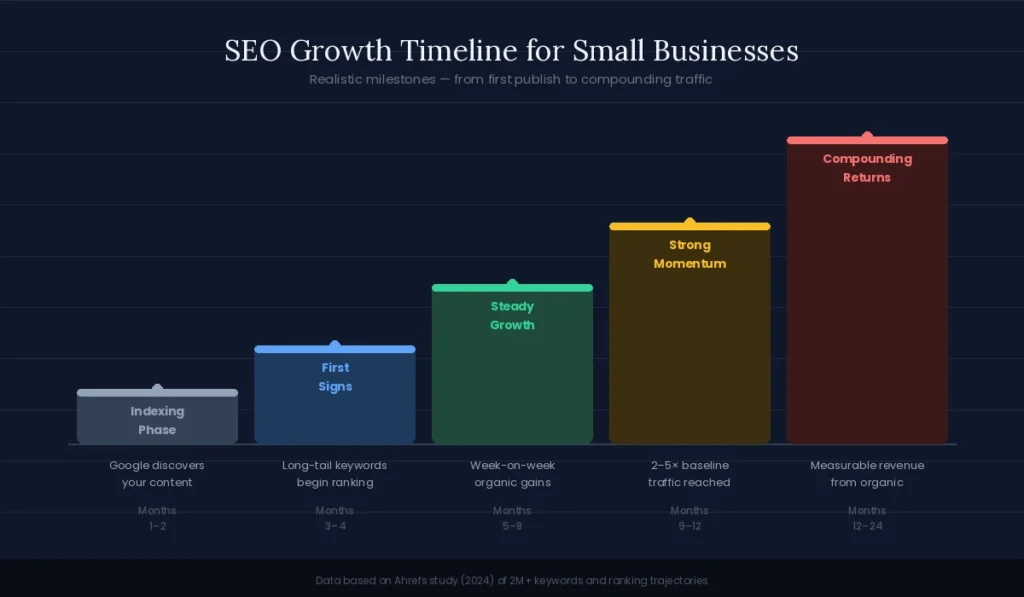
SEO timelines vary by industry, competition, and how consistently you work at it. But there are some patterns that hold fairly reliably across businesses. The table below summarises what a realistic growth trajectory looks like for a small business starting SEO from scratch.
| Month | Typical organic sessions | What’s usually happening |
| 1–2 | Near zero to minimal | Google indexing new pages; trust being established |
| 3–4 | First signs of traction | Long-tail keywords starting to rank; GBP gaining impressions |
| 5–8 | Steady week-on-week growth | Early content earning links; domain authority slowly building |
| 9–12 | 2–5× initial baseline | Mid-competition keywords ranking; compounding effect visible |
| 12–24 | Significant, measurable impact | Brand recognition online; leads with lower acquisition cost |
Going Global Without Getting Lost
The jump from local to global sounds dramatic. In practice, it’s incremental. International SEO mostly adds one layer of complexity: making sure Google serves the right version of your content to the right audience. That means hreflang tags if you have multiple languages, genuinely localised content (not just translated), and some attention to whether your site loads acceptably in the regions you’re targeting.
The bigger challenge is usually not technical — it’s commitment. Real localisation requires understanding how customers in different markets talk about problems, what they trust, and what they’re searching for. A keyword that converts well in the US might have entirely different intent in the UK, even in the same language.
SEO for Business Growth 2026
People also ask (FAQ’s)
How long does SEO take to show results for a small business?
Most small businesses start seeing measurable organic traffic growth between months 3 and 6. Meaningful business impact — leads, conversions, revenue attributable to organic search — typically takes 6 to 12 months of consistent effort. The timeline shortens with more content published, stronger backlinks earned, and faster technical fixes.
Is SEO still worth it in 2025 with AI changing search?
Yes, arguably more so. AI-powered search (including Google’s AI Overviews) draws heavily on content it considers authoritative and well-structured — the same content that ranks well organically. Businesses with strong SEO foundations are better positioned to appear in AI-generated answers than those without one. The fundamentals haven’t changed; the stakes have increased.
What’s the difference between local SEO and regular SEO?
Local SEO focuses on visibility in location-based searches — “near me” queries, Google Maps results, and the local 3-pack. It relies heavily on your Google Business Profile, local citations, and reviews. Regular (or “organic”) SEO targets broader keyword rankings across search results pages. Most small businesses need both, with local SEO being the faster win initially.
How much content do I need to publish to see SEO results?
Quality beats quantity consistently. Two genuinely helpful, well-researched posts per month will outperform ten thin articles stuffed with keywords. That said, more consistent publishing does build authority faster. A realistic starting pace is one to two substantial pieces per month, expanding as you see what resonates and what ranks.
Can a small business compete with large brands in search?
Yes — often effectively. Large brands struggle to rank for highly specific, local, or niche queries. Small businesses can dominate these “long-tail” searches by being genuinely specific and locally relevant. A regional bakery can outrank a national chain for “sourdough bread delivery [city]” because the large brand’s content isn’t built for that specificity.
A Few Things Worth Saying Plainly
SEO isn’t magic, and anyone selling guaranteed rankings in 30 days is not being honest with you. It’s also not as mysterious as some consultants would like it to seem. The core of it — build a good website, write helpful content, earn genuine links, be technically sound — hasn’t really changed in a decade. What changes is how you execute that at each stage of your business.
The businesses that grow meaningfully through search are usually the ones that commit to it as infrastructure rather than treating it as a campaign. keep publishing when traffic is flat. They fix technical issues without being asked. They respond to every review. That consistency is, ironically, rarer than most people think — and that’s exactly why it works.
References
- [1]BrightEdge Research (2023). “Organic Search Is Still Delivering Half of Web Traffic.” brightedge.com
- [2]BrightEdge Channel Performance Report (2023). Organic search traffic share analysis across 1,000+ brands. brightedge.com
- [3]Search Engine Journal (2022). “SEO Lead Close Rate vs Outbound.” — originally citing HubSpot State of Marketing data. searchenginejournal.com
- [4]Moz (2024). Beginner’s Guide to SEO — organic vs paid click data. moz.com/beginners-guide-to-seo
- [5]Google Search Central (2025). “What is a helpful, reliable, people-first content?” developers.google.com/search
- [6]Ahrefs Blog (2024). “How Long Does SEO Take?” — analysis of 2M keywords and ranking timelines. ahrefs.com/blog