
Best Small Business to Start Online in 2026: Your Complete Guide to Digital Success
The digital entrepreneurship landscape in 2026 presents unprecedented opportunities for aspiring business owners. With global ecommerce revenue projected to surpass $6.4 trillion this year and 33% of U.S. adults planning to start a new business or side hustle, the online business environment has never been more promising.
Understanding the 2026 Online Business Landscape
The entrepreneurial ecosystem has experienced dramatic growth, with over 150 million startups operating worldwide and approximately 50 million new ventures launching annually. Americans are entering 2026 with remarkable entrepreneurial energy, showing a 94% increase in business intent compared to the previous year.
Best Small Business to Start Online in 2026: Key Market Statistics for 2026
| Metric | Value | Source |
| Global Ecommerce Revenue | $6.42 trillion | Flowlu |
| U.S. Ecommerce Revenue | $1.17 trillion | BigCommerce |
| Average Startup Cost | $12,000 (median) | QuickBooks |
| Online Business First-Year Revenue | $50,000 (average) | Business.org |
| Percentage Using AI Tools | 60%+ of new entrepreneurs | QuickBooks |
| Social Commerce Growth | 104 million U.S. shoppers | Flowlu |
Top 7 Online Businesses to Start in 2026
1. Digital Marketing Agency
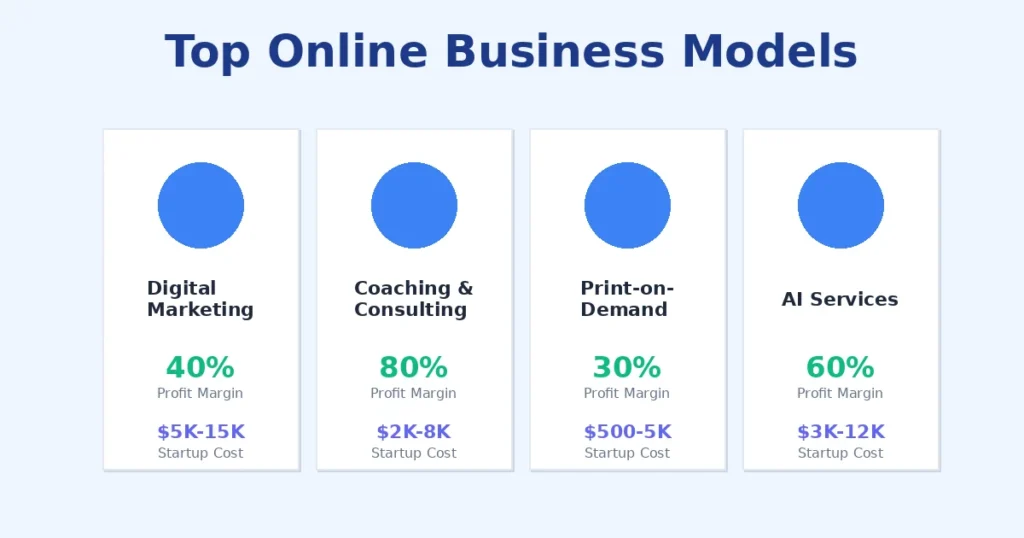
Digital marketing agencies continue to dominate as one of the most profitable online business models in 2026. With businesses increasingly recognizing the importance of online presence, demand for digital marketing services remains exceptionally high.
Startup Investment: $5,000 – $15,000
Profit Margins: 20-40% net, 50-75% gross
Revenue Potential: $100,000 – $500,000+ annually
Digital marketing encompasses social media management, search engine optimization, content creation, email marketing, and paid advertising. The beauty of this business model lies in its scalability and relatively low overhead costs. You can start from home with basic software subscriptions and expand as you acquire clients.
Why It Works: Businesses of all sizes need digital marketing expertise but often lack in-house capabilities. The shift toward AI-powered marketing tools hasn’t eliminated the need for human strategists—instead, it has created opportunities for agencies that can effectively combine AI efficiency with creative human insight.
2. Online Coaching and Consulting
The coaching industry has evolved significantly, with specialized niches offering substantial earning potential. From career coaching to business consulting, wellness coaching to skill development, the opportunities are diverse and lucrative.
Startup Investment: $2,000 – $8,000
Profit Margins: 60-80%
Revenue Potential: $50,000 – $200,000+ annually
By 2027, over 50% of the U.S. workforce is expected to engage in freelance work, creating massive demand for coaching services that help professionals navigate career transitions. The human element of coaching—providing accountability, emotional support, and personalized guidance—cannot be replicated by AI, making this a sustainable long-term business model.
Success Factors: Establish a clear niche, build a strong personal brand, leverage social media for visibility, and create scalable offerings through group programs or digital courses alongside one-on-one coaching.
3. Print-on-Demand Ecommerce
Print-on-demand (POD) businesses eliminate traditional inventory challenges while tapping into the massive ecommerce market. This model allows entrepreneurs to create custom designs for products like apparel, home decor, phone cases, and drinkware without holding inventory.
Startup Investment: $500 – $5,000
Profit Margins: 15-30%
Revenue Potential: $30,000 – $150,000+ annually
Growth sectors within POD include electronics accessories (projected 18.1% growth), household items (22.2% growth), and food-related products (24.1% growth). The key to success lies in identifying underserved niches and creating designs that resonate with specific target audiences.
Platform Integration: Shopify, Etsy, and specialized POD platforms make it easier than ever to set up shop and start selling within days. Integration with social commerce platforms like TikTok Shop provides additional revenue channels.
4. AI-Powered Services and Automation
Artificial intelligence has created entirely new business categories in 2026. Entrepreneurs who can bridge the gap between AI capabilities and business needs are finding exceptional opportunities.
Startup Investment: $3,000 – $12,000
Profit Margins: 40-60%
Revenue Potential: $75,000 – $250,000+ annually
Service Opportunities:
- AI automation setup for ecommerce businesses
- Chatbot development and integration
- AI-powered content creation services
- Workflow automation consulting
- Custom AI tool implementation
The AI sector attracted nearly $19 billion in venture funding in Q2 2025, representing 28% of all venture capital. While many AI startups face high failure rates (90%), service-based businesses that implement AI for clients—rather than creating AI products—enjoy much higher success rates.
5. Creator Economy Services
The creator economy has matured into a multi-billion dollar ecosystem, and creators need specialized services to scale their businesses. This presents lucrative opportunities for entrepreneurs willing to serve this growing market.
Startup Investment: $2,000 – $10,000
Profit Margins: 35-55%
Revenue Potential: $60,000 – $200,000+ annually
High-Demand Services:
- Video editing and content repurposing
- Thumbnail design and optimization
- Community management
- Sponsorship brokerage (15% commission on deals)
- Digital business management for course creators ($3,000-$5,000 monthly retainers)
Statistics show that 71% of micro-influencers (10,000-80,000 followers) have never seen a media kit, and 83% edit their own videos—revealing significant service gaps. These creators monetize faster than macro influencers due to concentrated trust but lack professional support systems.
6. Subscription-Based Digital Products
Recurring revenue models offer predictability and scalability that one-time sales cannot match. Digital subscription businesses range from software-as-a-service (SaaS) to membership communities and content libraries.
Startup Investment: $5,000 – $20,000
Profit Margins: 50-80%
Revenue Potential: $50,000 – $300,000+ annually
Popular Subscription Models:
- Niche software tools (productivity, design, automation)
- Template and resource libraries
- Premium content and research
- Online learning platforms
- Exclusive community access
The key advantage of subscription models is customer lifetime value. Instead of continuously acquiring new customers, you focus on retention and expanding service value to existing subscribers.
7. Virtual Assistance and Specialized Services
The rise of remote work has accelerated demand for virtual assistants, particularly those with specialized skills beyond administrative tasks.
Startup Investment: $1,000 – $5,000
Profit Margins: 50-70%
Revenue Potential: $40,000 – $100,000+ annually
Specialized VA Services:
- Social media management
- Email marketing automation
- Customer service and chat support
- Bookkeeping and financial administration
- Project management
Virtual assistants who develop expertise in specific platforms (HubSpot, Salesforce, Shopify) or industries (real estate, healthcare, legal) can command premium rates of $50-100+ per hour compared to $15-25 for general administrative work.
Essential Considerations Before Starting
Market Research and Validation
Before investing time and money, validate your business idea through market research. Use tools like Google Trends, social media listening, and competitor analysis to confirm demand exists for your proposed service or product.
Technology and Tools Investment
Modern online businesses require strategic technology investments:
| Tool Category | Monthly Cost Range | Purpose |
| Website/Ecommerce Platform | $29-$299 | Shopify, WordPress, Wix |
| Email Marketing | $0-$150 | Mailchimp, ConvertKit |
| Social Media Management | $0-$99 | Buffer, Hootsuite |
| Accounting Software | $15-$70 | QuickBooks, FreshBooks |
| Design Tools | $0-$55 | Canva Pro, Adobe Express |
| AI Tools | $20-$200 | ChatGPT, Jasper, Claude |
Financial Planning and Cash Flow
Poor cash flow management contributes to 82% of business failures. Create detailed financial projections covering at least your first year, including:
- Initial startup costs
- Monthly operating expenses
- Revenue projections (conservative estimates)
- Break-even timeline
- Emergency fund reserves (3-6 months of expenses)
Best Small Business to Start Online in 2026: Leveraging 2026 Technology Trends
Artificial Intelligence Integration
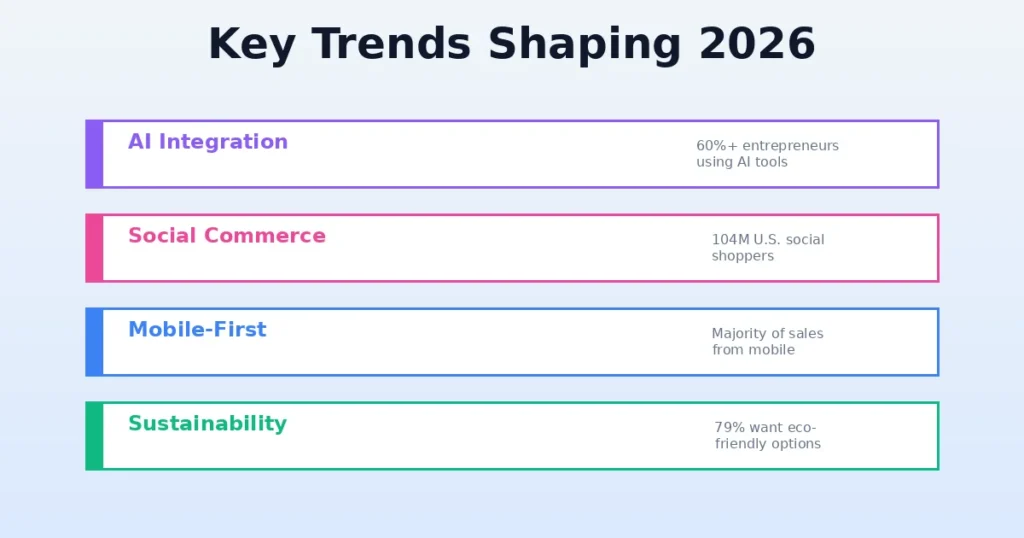
More than 60% of aspiring entrepreneurs plan to use AI tools to launch their businesses in 2026, with Millennials leading at 75%. AI applications include:
- Content creation and copywriting
- Customer service automation
- Data analysis and insights
- Personalized marketing campaigns
- Operational efficiency improvements
Social Commerce Optimization
Social platforms have evolved into complete shopping ecosystems. TikTok alone is expected to reach nearly 40 million shoppers by late 2026, with 43% of Gen Z consumers searching for products on TikTok before traditional search engines.
Social Commerce Strategy:
- Create shoppable content on Instagram, TikTok, and Facebook
- Leverage user-generated content for authenticity
- Implement influencer partnerships
- Utilize platform-native checkout features
- Engage with comments and build community
Mobile-First Approach
Mobile devices account for the majority of online sales in 2026. Ensure your business is optimized for mobile experiences:
- Responsive website design
- Fast loading speeds (under 3 seconds)
- Simplified checkout processes
- Mobile-friendly content formats
- App-based solutions where appropriate
People Also Ask(FAQ’s)
How much money do I need to start an online business in 2026?
The median startup cost for an online business is approximately $12,000, though many successful ventures begin with $5,000 or less. Service-based businesses (coaching, consulting, virtual assistance) can start with under $3,000, while ecommerce and SaaS businesses may require $10,000-$20,000 for inventory, platform development, and initial marketing.
What is the most profitable online business to start?
Digital marketing agencies and SaaS businesses typically offer the highest profit margins (50-75% gross margins), followed by coaching and consulting services (60-80%). However, profitability depends heavily on execution, market positioning, and operational efficiency rather than business model alone.
Can I start an online business with no experience?
Yes, though success probability increases with relevant experience. Consider starting with low-barrier businesses like virtual assistance, content creation, or dropshipping to gain experience while generating income. Invest time in online courses, mentorship programs, and industry communities to accelerate your learning curve.
How long does it take for an online business to become profitable?
Only 15% of businesses become profitable within the first year. Most online businesses require 12-18 months to reach profitability, though this varies significantly by business model. Service-based businesses often achieve profitability faster (6-12 months) than product-based businesses (12-24 months) due to lower overhead and inventory costs.
What are the biggest mistakes to avoid when starting an online business?
The top mistakes include: insufficient market research (no product-market fit), premature scaling (expanding before establishing solid foundations), poor cash flow management, underestimating customer acquisition costs, neglecting customer service, and failing to differentiate from competitors. Additionally, 46% of business owners are surprised by tax obligations, so proper financial planning is essential.
Best Small Business to Start Online in 2026: Taking the First Step
Success requires more than selecting the right business model—it demands market validation, financial discipline, continuous learning, and adaptability to evolving trends. Start with thorough research, create a solid business plan, leverage modern technology tools, and focus relentlessly on delivering value to your target customers.
Whether you choose digital marketing, coaching, ecommerce, AI services, or any other online business model, remember that 40% of startups achieve profitability through strategic execution and persistent optimization. Your journey begins with a single step—choose your path and commit to building something meaningful in 2026.
References
- BigCommerce. (2026). “Top Ecommerce Trends to Watch in 2026.” Retrieved from https://www.bigcommerce.com/articles/ecommerce/ecommerce-trends/
- Flowlu. (2025). “E-commerce Statistics 2026: Global, Mobile, Social, B2B Data.” Retrieved from https://www.flowlu.com/blog/productivity/ecommerce-statistics/
- Bankrate. (2025). “Average Cost of Starting a Small Business.” Retrieved from https://www.bankrate.com/loans/small-business/small-business-average-cost/
- Shopify. (2026). “10 Small Business Trends Shaping Commerce in 2026.” Retrieved from https://www.shopify.com/blog/small-business-trends




One Comment on “Best Small Business to Start Online in 2026”