Affiliate Marketing Mistakes 2026: What’s Quietly Killing Your Commissions Right Now
Affiliate Marketing Mistakes 2026: What’s Quietly Killing Your Commissions Right Now: Still making the same affiliate marketing mistakes everyone warned you about years ago? In 2026, the game has shifted — and what used to work is now working against you. From chasing the wrong traffic to ignoring AI-driven search behavior, this guide breaks down the real mistakes costing affiliates thousands every month. Whether you’re just getting started or wondering why your once-profitable site has gone quiet, here’s an honest, data-backed look at what’s actually going wrong — and what you can do before your next commission check
Affiliate Marketing Mistakes 2026:
The affiliates who are struggling right now aren’t necessarily lazy or uninformed. The problem is they’re working on the wrong things, or they’re holding onto approaches that quietly stopped working 18 months ago but nobody told them.
Let’s talk about what’s actually going on.
The Landscape Has Genuinely Changed
Before we get into the mistakes, it’s worth grounding this in what’s actually happening in the affiliate world right now.
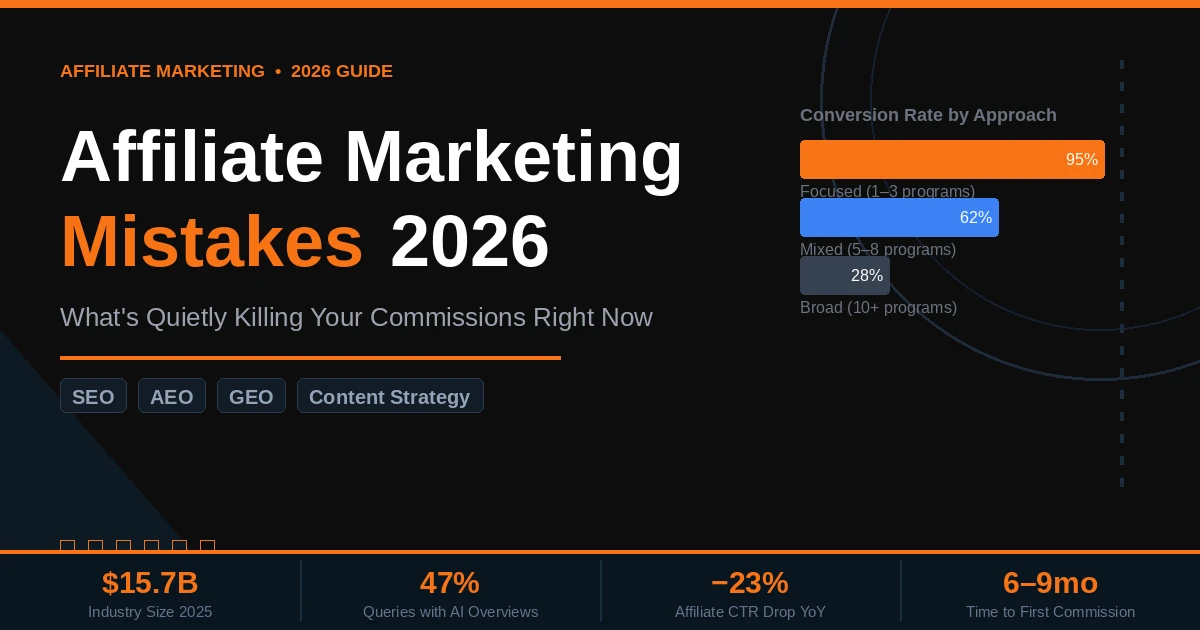
Search behavior has shifted in a meaningful way. AI Overviews on Google (formerly SGE) now appear on roughly 47% of all search queries as of early 2026, according to data from Semrush. That directly compresses click-through rates for traditional affiliate content sitting in positions 1–3. Meanwhile, platforms like ChatGPT, Perplexity, and Claude are being used as product research tools by millions of people who would previously have landed on your comparison article.
This isn’t doom and gloom — it’s context. The affiliates doing well in 2026 understand that the content game, the trust game, and the distribution game have all changed simultaneously.
Affiliate Marketing Mistakes 2026: Key Affiliate Industry Stats (2025–2026)
| Metric | Data Point | Source |
|---|---|---|
| Global affiliate marketing spend | $15.7 billion (2025) | Influencer Marketing Hub |
| Average affiliate CTR from AI search results | Down 23% YoY | Semrush, Q1 2026 |
| % of affiliates using AI tools for content | 71% | Authority Hacker Survey, 2025 |
| Affiliate programs offering higher commissions for reviews | 38% increase | ShareASale Annual Report, 2025 |
| Consumers who trust UGC over brand content | 84% | Nielsen Trust Report |
| Average time before new affiliate site earns first commission | 6–9 months | Ahrefs Case Study Data |
Mistake 1: Writing for Google, Not for People
This one sounds obvious because it’s been said a thousand times. The problem is that in 2026, it’s more damaging than it’s ever been.
Google’s Helpful Content system has had multiple updates since its original rollout, and the pattern is consistent: sites that exist primarily to funnel clicks are losing visibility. But here’s the part people miss — it’s not just about sounding helpful.
A lot of affiliate content today is what you might call “opinion-shaped filler.” It follows the structure of a genuine review but contains no actual experience, no real data, no honest negative takes. Readers feel it immediately. They bounce. Google notices.
The affiliates outperforming in 2026 are the ones writing like they’d talk to a friend who asked them for a recommendation. That means including the downsides of products, being honest about who a product is not for, and not treating every item as a 9/10 must-buy.
Why “Review Farming” Is a Dead End
Review farming — the practice of producing high volumes of templated reviews across a broad niche — was already fragile. In 2026 it’s functionally broken for most practitioners. Google’s product reviews guidance explicitly rewards content that demonstrates first-hand expertise. Sites without that signal are being filtered out at scale.
Mistake 2: Ignoring Answer Engine Optimization (AEO)
This is the mistake most affiliates haven’t even heard of yet, which is exactly why it matters.
AEO — Answer Engine Optimization — is the practice of structuring your content to be surfaced by AI answer tools: ChatGPT, Perplexity, Google’s AI Overviews, and others. These tools don’t just scrape your title tag. They look for clearly structured, factually specific, well-attributed content that can be quoted or summarized confidently.
If your affiliate article can’t be easily summarized by an AI model, it’s unlikely to be referenced by one either. And that’s an increasingly large source of product research traffic.
Practical AEO tactics for affiliates:
- Use clear question-and-answer formatting within content
- Include specific, verifiable claims (prices, specs, comparison data)
- Structure FAQs with concise, direct answers — not keyword-stuffed paragraphs
- Get cited or linked by authoritative sources in your niche
Mistake 3: Stacking Too Many Programs at Once
New affiliates often fall into this trap: sign up for 12 different affiliate networks, add links to everything, and see what converts. The result is usually a site that feels transactional, loads slowly (due to multiple tracking scripts), and generates nothing of real value for the reader.
Focused affiliate sites — those built around 2–4 complementary programs in a well-defined niche — consistently outperform the “link to everything” approach. It comes down to editorial credibility. When your site recommends a specific type of tool and backs it up with depth, readers trust you more and convert better.
Affiliate Marketing Mistakes 2026: Program Focus vs. Program Volume: A Rough Comparison
| Approach | Avg. Conversion Rate | Trust Signal | Content Depth |
|---|---|---|---|
| 1–3 focused programs | 3.2–5.1% | High | High |
| 5–8 mixed programs | 1.8–2.9% | Medium | Medium |
| 10+ programs, broad niche | 0.6–1.4% | Low | Low |
Data aggregated from case studies published by Niche Pursuits and The Affiliate Lab (2024–2025)
Mistake 4: Underestimating the Cookie Window Problem
Affiliate cookies are getting shorter. Apple’s ITP (Intelligent Tracking Prevention), browser-level privacy updates, and advertiser policy changes have collectively compressed attribution windows in ways that most affiliates haven’t fully absorbed.
The fix isn’t technical — it’s strategic. Build content that captures buyers closer to decision time: “best [product] deals this week,” comparison tables between two specific models, “should I buy X or Y” head-to-heads. These attract lower-funnel intent and convert inside shorter attribution windows.
Mistake 5: Building on Borrowed Ground
This is the mistake with the longest-term consequences and the one people acknowledge the least while they’re making it.
Building your affiliate business primarily on:
- One Google traffic source
- One social platform (TikTok, YouTube, Instagram)
- One affiliate program (especially Amazon Associates)
…is not a business. It’s a bet. And in 2026, the risk is as high as it’s ever been.
Amazon has cut commission rates multiple times. TikTok’s regulatory situation in several markets remains uncertain. Google’s algorithm can and does devastate sites with no warning. Any one of these can end a business that has no diversification.
Mistake 6: Skipping the Trust Infrastructure
In a world where anyone can generate 50 product reviews in an afternoon using AI, the differentiator is trust. Not quality in the abstract — actual verifiable trust signals.
What does that look like?
- Author bios with real credentials — not “John is a passionate writer about tech”
- Disclosure that’s clear, not buried — readers actually respect honesty when it’s upfront
- Contact pages and social presence — anonymous affiliate sites are being devalued across the board
- Linking out to sources — demonstrates research rather than isolation
Google’s E-E-A-T (Experience, Expertise, Authoritativeness, Trustworthiness) framework actively rewards these signals. More importantly, readers reward them with return visits and purchase confidence.
People Also Ask( FAQ’s)
Q: Is affiliate marketing still profitable in 2026?
Yes — but the low-effort model is largely gone. Affiliates with real expertise, solid content strategies, and diversified traffic are still generating strong income. The industry is projected to exceed $17 billion by 2027 (Statista).
Q: How long does it take to make money with affiliate marketing in 2026?
Realistically, 6–12 months for a new site to generate consistent income, assuming regular content production and a defined SEO strategy.
Q: Does AI content hurt affiliate site rankings?
Pure AI content with no human editing, real experience, or added value tends to underperform in current rankings. AI-assisted content reviewed and enriched by a human with genuine subject knowledge performs comparably to fully human-written content.
Q: What affiliate niches are working in 2026?
Finance, health, SaaS tools, home improvement, and sustainable living remain strong. Hyper-specific sub-niches outperform broad categories — “best budgeting apps for freelancers” over “best budgeting apps.”
Q: What’s the biggest affiliate marketing mistake beginners make?
Choosing a niche based on commission rates rather than genuine knowledge or audience interest. High commissions mean nothing if you can’t build content authority in the space.
Affiliate Marketing Mistakes 2026: A Final Honest Note
The people still trying to game their way to commissions are finding it harder every quarter. The ones building real publishing businesses — with a clear audience, genuine expertise, and actual opinions — are finding that the competition has thinned considerably.
The mistakes above aren’t new in concept. But in 2026, the consequences of making them are faster and harder to reverse. If any of them sounded familiar, that’s not a bad thing. It means you have something specific to fix — and that’s a much better position than not knowing where the leak is.
References & Authoritative Sources
- Semrush State of Search 2026 Report — semrush.com
- Authority Hacker: The State of Affiliate Marketing 2025 — authorityhacker.com
- Google Search Central: Product Reviews System Documentation — developers.google.com/search
- Influencer Marketing Hub: Affiliate Marketing Benchmark Report 2025 — influencermarketinghub.com
- Nielsen Consumer Trust Report — nielsen.com
- ShareASale 2025 Annual Network Report — shareasale.com
- Statista: Affiliate Marketing Global Revenue Forecast — statista.com
- Niche Pursuits: Affiliate Site Case Studies — nichepursuits.com