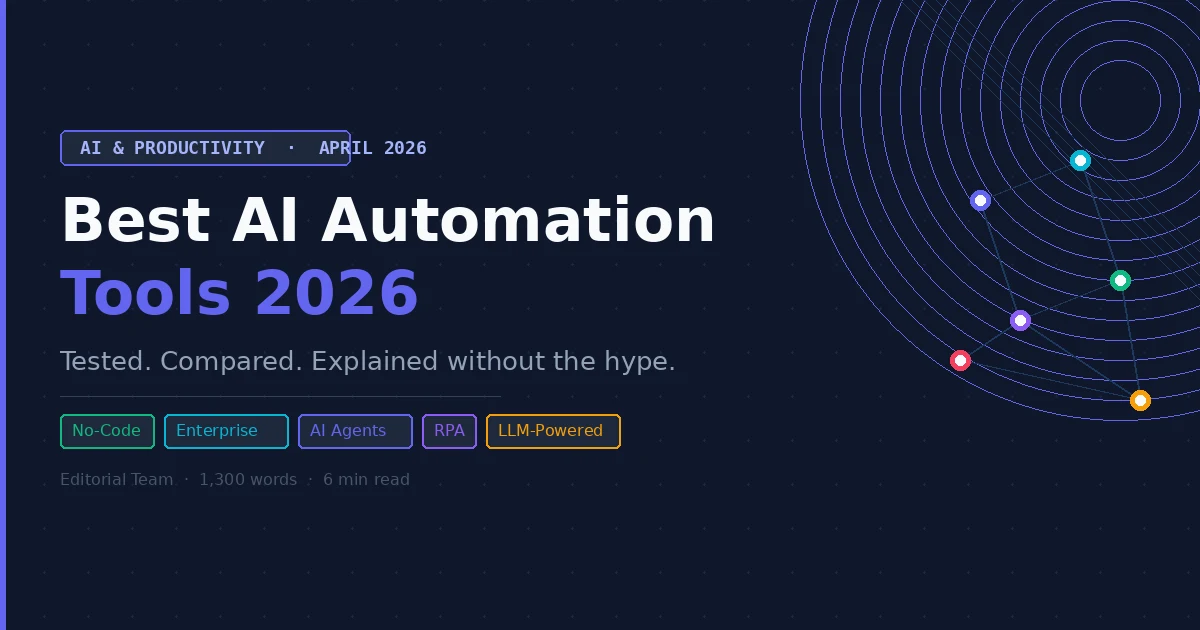
The Best AI Automation Tools 2026
Discover the best AI automation tools of 2026 — from no-code platforms like Zapier and Make.com to enterprise-grade RPA tools like UiPath. Honest comparisons, real data, and clear recommendations to help you choose the right tool for your workflow.
The landscape in 2026 looks genuinely different from even two years ago. AI agents — systems that can reason, decide, and act without constant human instruction — have moved from research papers into real products people use every day. Tools that used to just connect apps are now learning your habits, writing their own logic, and flagging exceptions before you even notice them.
The ones actually worth your time — tested, compared, and explained without the hype
What “AI Automation” Actually Means in 2026
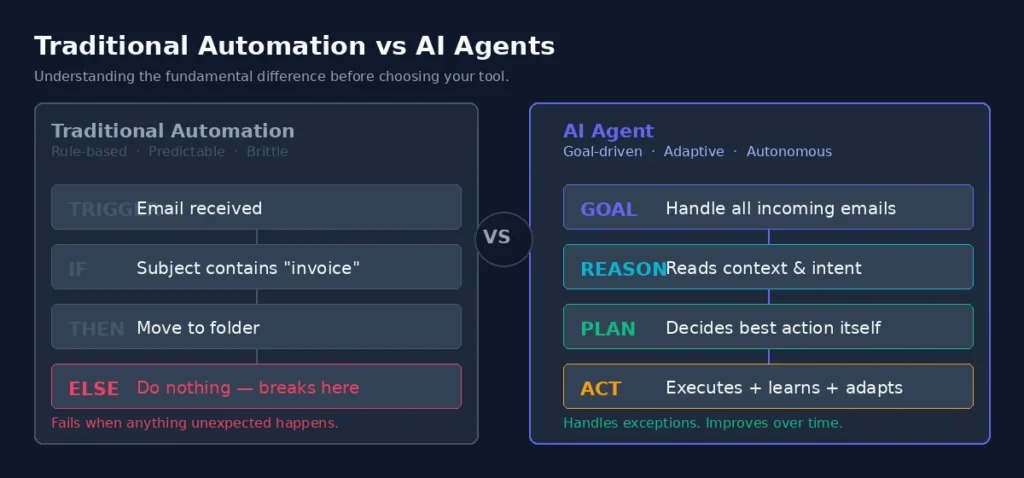
Before the tool list, it’s worth spending sixty seconds on what has actually changed. Traditional automation was rule-based — if this happens, do that. Reliable, but brittle. The moment something unexpected showed up, it broke. Modern AI automation adds a layer of judgment. Tools can now read unstructured text, interpret intent, handle exceptions, and even suggest improvements to the workflow itself.
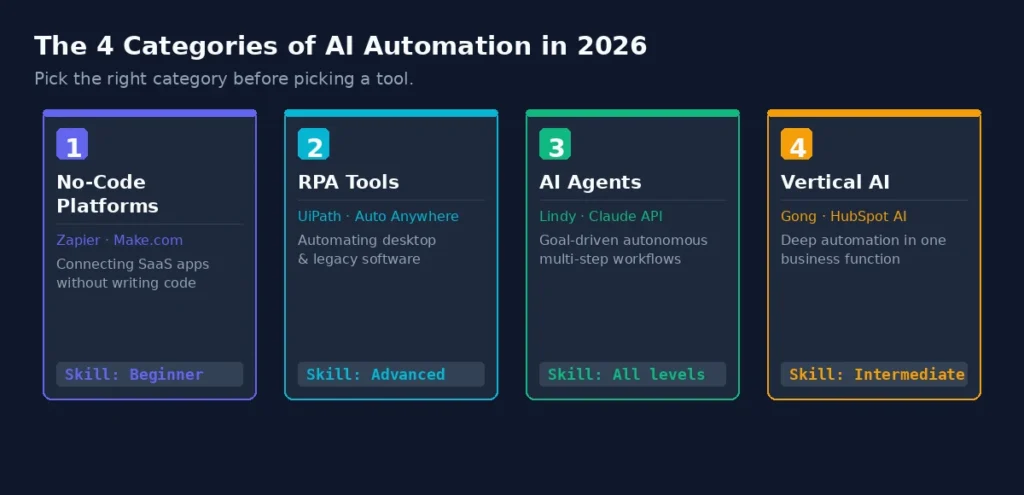
There are roughly four categories worth knowing about, because choosing the wrong category wastes more time than having no tool at all:
- No-code / low-code workflow platforms — Zapier, Make.com, n8n. Best for connecting SaaS apps and automating repetitive tasks.
- RPA (Robotic Process Automation) — UiPath, Automation Anywhere. Built for automating desktop and legacy software that has no API.
- AI agents and agentic platforms — Lindy, Claude API workflows. Reason, plan, and act independently across multi-step tasks.
- Vertical AI tools — Gong for sales, HubSpot AI for marketing, WorkFusion for finance. Deeply specialised but very powerful in their lane.
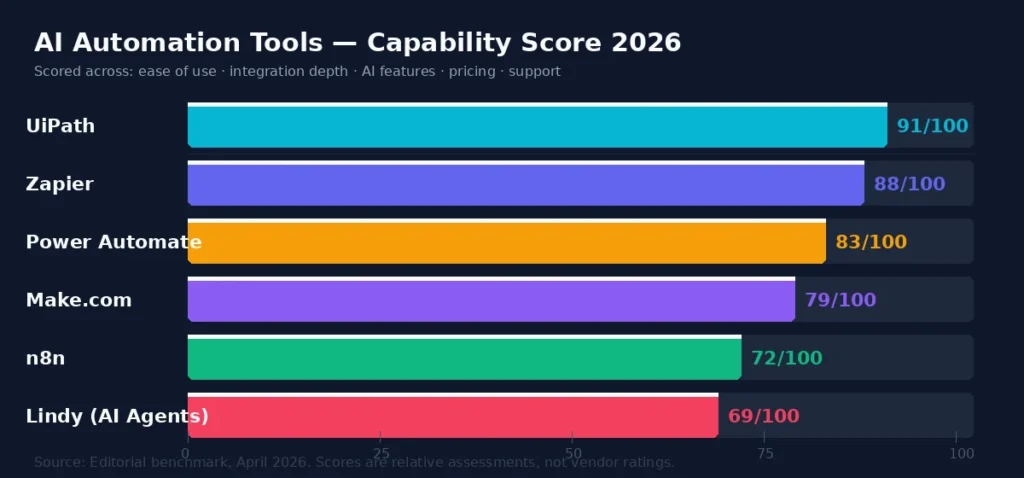
The Best AI Automation Tools of 2026 — Compared
| Tool | Best For | Skill Level | Free Plan | Starting Price |
|---|---|---|---|---|
| Zapier | SaaS app connections | Beginner | Yes (100 tasks/mo) | $19.99/month |
| Make.com | Complex visual workflows | Intermediate | Yes (1,000 ops/mo) | $9/month |
| UiPath | Legacy & desktop automation | Advanced | Community edition | Enterprise pricing |
| n8n | Self-hosted, developer-first | Technical | Self-host free | €20/month (cloud) |
| Microsoft Power Automate | Microsoft 365 ecosystems | Intermediate | With M365 | $15/user/month |
| Lindy | AI agent workflows | Beginner | Yes | Usage-based |
| HubSpot AI (CRM) | Sales & marketing teams | Beginner | Yes | $20/seat/month |
| Gong AI | B2B sales pipeline | Intermediate | No | Custom |
Zapier — Still the Easiest Entry Point
Category: No-code workflow automation | 7,000+ app integrations
Zapier is where most people start, and honestly, it’s where a lot of people stay — not out of laziness but because it genuinely does what they need. The interface is conversational now. You describe what you want in plain English, and the AI builds the workflow structure for you. That shift alone makes onboarding dramatically faster for non-technical users.
The limitation is that Zapier works best when your data is clean and your apps all have decent APIs. When things get messy — conditional logic, large data volumes, or anything that touches a spreadsheet in a complex way — you start bumping against ceilings.
Best for: Small teams, solopreneurs, marketing workflows, and anyone who wants something working in an afternoon.
Make.com — When You Need More Control
Category: Visual workflow builder | 1,400+ integrations
Make.com (formerly Integromat) has a visual canvas that shows you exactly what is happening at every step of a workflow. For people who think in systems, this is genuinely satisfying to use. You can build branching logic, iterate through arrays, and handle error paths without writing code. The pricing also tends to work out cheaper than Zapier for high-volume operations.
UiPath — The RPA Heavyweight
Category: Robotic Process Automation (RPA) | Enterprise-grade
UiPath is a different beast. It automates by watching what a human does on screen — clicking, typing, navigating — which means it can handle the software that has no API at all: legacy ERPs, old government portals, internal tools built a decade ago. In 2026, UiPath has expanded into AI-guided decision-making alongside its traditional screen-based automation.
WorkFusion (a competitor in this space) deployed “digital analysts” at HSBC that reduced invoice processing time by 81% and flagged $120M in potential fraud in 2025 alone. That gives you a sense of the scale RPA tools can reach when properly implemented.
Best for: Enterprise teams, finance, healthcare, and any organisation still running software without a modern API.
n8n — The Developer’s Favourite
Category: Open-source workflow automation | Self-host or cloud
n8n sits in an interesting spot. It’s open-source, which means you can host it yourself and pay nothing. The workflow builder is visual like Make.com, but you can also drop into code when you need to. For teams with a developer or two, n8n offers maximum flexibility and control without handing your data over to a third party — which matters more every year.
Best for: Technical teams, privacy-conscious organisations, and anyone building complex AI pipelines on a budget.
The Best AI Automation Tools 2026: AI Agents: The Category That Changed Everything
The most significant shift in 2026 is the mainstream arrival of genuine AI agents. These aren’t just tools that run workflows — they’re systems that can be given a goal and figure out the steps themselves. You tell an agent “research competitors and draft a summary every Monday” and it handles the research, reading, writing, and scheduling without you mapping out each step.
“80% of Fortune 500 companies are already running active AI agents in production — not because they’re experimenting, but because those who didn’t act are losing ground fast.” — Microsoft Enterprise Telemetry Data, 2026
Tools like Lindy sit in this space for smaller teams. The Claude API (from Anthropic) is being used by developers and enterprises to build custom agentic workflows — document processing, customer support routing, code generation pipelines — at scale. HubSpot’s AI content engine, which generates, personalises, and A/B tests email copy autonomously, reported 22% higher conversion rates in live trials according to HubSpot’s 2025 Impact Report.
How to Pick the Right One for Your Situation
The honest answer is that the “best” tool depends entirely on your context. A freelancer automating invoice reminders needs something very different from an enterprise finance team processing thousands of invoices daily. Here’s a practical decision path:
| Your Situation | Recommended Starting Point |
|---|---|
| No technical background, need quick wins | Zapier or HubSpot AI |
| Moderately technical, complex logic needed | Make.com or Power Automate |
| Developer on the team, want full control | n8n (self-hosted) |
| Legacy systems with no API access | UiPath or Automation Anywhere |
| Want autonomous AI agents, not just rules | Lindy or Claude API workflows |
| Sales or marketing team, CRM-heavy | HubSpot AI or Gong AI |
One thing that is worth saying plainly: do not chase the most powerful tool just because it seems impressive. The best automation stack is the one your team actually uses. A Zapier workflow that runs reliably beats a sophisticated n8n pipeline that nobody maintains.
People Also Ask(FAQ’s)
What is the best AI automation tool for small businesses in 2026?
For most small businesses, Zapier remains the easiest starting point because of its large app library and conversational workflow builder. Make.com is a strong second choice if you need more complex logic at a lower price point. Both have free plans to get started without commitment.
Is UiPath still worth it in 2026?
Yes, particularly for enterprises dealing with legacy software that lacks APIs. UiPath has expanded into AI-guided decision-making alongside its traditional screen-automation capabilities, making it more versatile than it was a few years ago. For teams without legacy software needs, lighter tools are usually a better fit.
What’s the difference between n8n and Zapier?
Zapier is cloud-only, designed for non-technical users, and prioritises ease of setup. n8n is open-source, can be self-hosted, supports code when needed, and gives developers far more control. Zapier gets you running in an hour; n8n can do things Zapier simply cannot — but it takes longer to set up and maintain.
Are AI automation tools replacing jobs?
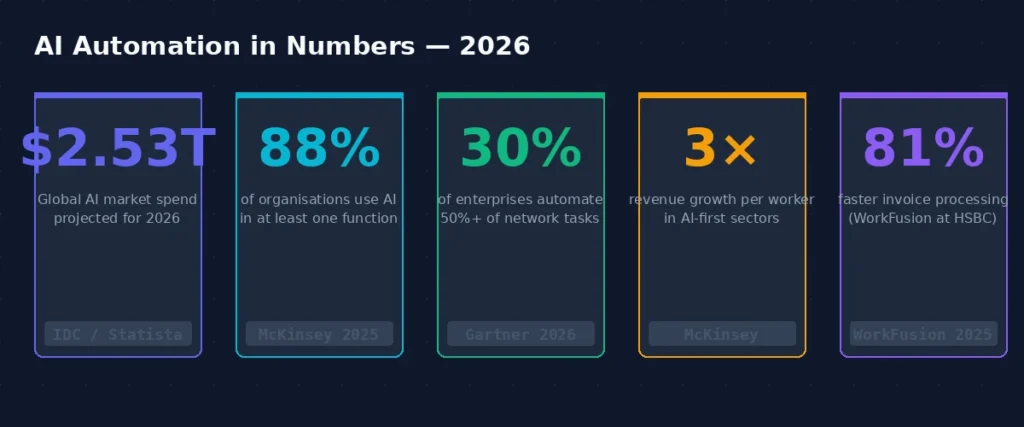
The evidence suggests a shift rather than wholesale replacement. AI automation handles repetitive, rule-based tasks, freeing people for higher-judgment work. McKinsey data shows sectors with high AI adoption see three times higher revenue growth per worker, which implies more value creation rather than simple headcount reduction — though individual roles are undoubtedly changing.
What is an AI agent and how is it different from regular automation?
Regular automation follows rules you define — if this, then that. AI agents can be given a goal and determine the steps themselves. They can reason, handle unexpected situations, use multiple tools in sequence, and loop back when something doesn’t work. Think of the difference between a vending machine and a personal assistant.
Which AI automation tool has the best free plan?
n8n is the most generous if you self-host — it’s completely free. Among cloud platforms, Make.com offers 1,000 operations per month free, which is more generous than Zapier’s 100 tasks. Zapier’s free plan is more limited but covers many simple use cases for individuals.
The Best AI Automation Tools 2026: A Note on Implementation Reality
This is the part that gets left out of most tool comparisons: the tools themselves are often the easy bit. The harder parts are data quality (garbage in, garbage out applies more than ever with AI), change management (getting your team to actually trust and use automated workflows), and maintenance (workflows break when upstream apps change their APIs or layouts).
Start small. Pick one process that is genuinely painful — something you or a colleague does manually every day that follows a predictable pattern. Automate that. Learn what breaks and why. Then expand. The companies getting the most from AI automation in 2026 are not the ones who bought the biggest platforms — they are the ones who started with discipline and scaled with understanding.
References & Authoritative Sources
- Gartner — Network Automation Forecast 2026: 30% of enterprises to automate over half of network activities by 2026.
- McKinsey & Company — The State of AI 2025: 88% of organisations use AI in at least one business function.
- HubSpot — 2025 Impact Report: AI Content Engine drives 22% higher conversion rates in live trials.
- WorkFusion — HSBC Case Study 2025: Digital analysts reduced invoice processing time by 81%.
- Gong Labs — 2025 Report: Gong AI Insights increased win rates by 19% for B2B SaaS firms.
- Microsoft — Enterprise Telemetry Data 2026: 80% of Fortune 500 companies running active AI agents in production.
- DronaHQ — Top AI Automation Tools 2026: Platform comparison across eight leading tools.
- IDC / Statista — Global AI market spend projected to reach $2.53 trillion in 2026 (44% year-on-year growth).