How to Find AI Innovation Ideas: A Practical Guide for Builders, Founders & Researchers
Discover proven strategies to find AI innovation ideas in 2026. Learn how to identify market gaps, use research tools, analyze trends, and turn raw concepts into scalable AI solutions — backed by data, stats, and authoritative sources.
AI INNOVATION MAPPING :How to Find AI Innovation Ideas
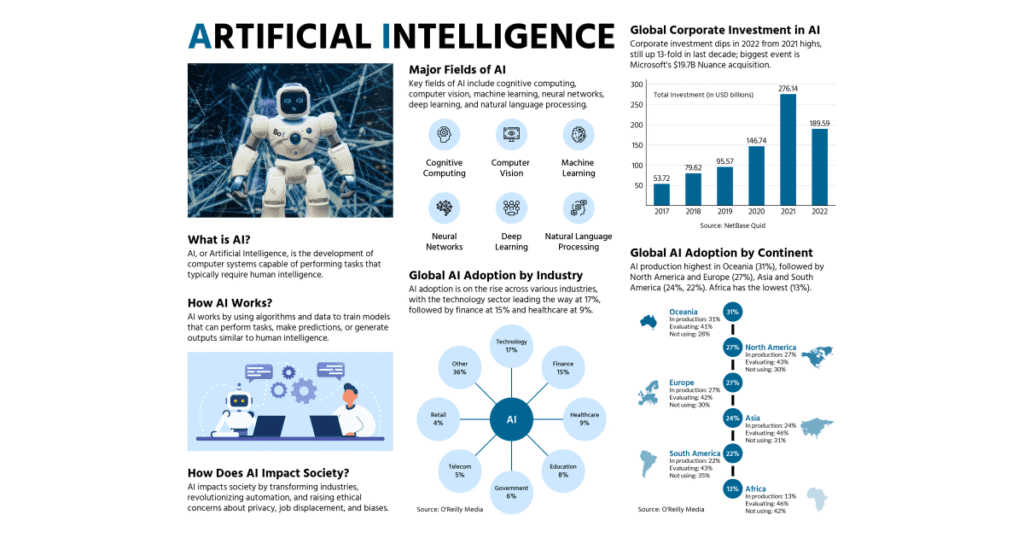
Artificial intelligence is no longer a futuristic concept reserved for research labs and Silicon Valley giants. In 2026, AI has become the engine behind healthcare diagnostics, financial forecasting, climate modeling, and personalized education. Yet, for all the buzz, one critical challenge remains stubbornly difficult: finding genuinely original AI innovation ideas that solve real problems, attract investment, and stand the test of competition.
Why Finding the Right AI Idea Is So Hard
Most people approach AI ideation backwards. They start with a technology — large language models, computer vision, reinforcement learning — The result is often a solution chasing a problem. The world doesn’t need another chatbot wrapper; it needs AI systems that remove genuine friction from human life.
“The most important question in AI is not ‘what can the model do?’ but ‘what would people pay to have done for them, reliably, at scale?'”— Andrew Ng, AI Fund & DeepLearning.ai
Step-by-Step: How to Find AI Innovation Ideas
A proven framework for researchers, founders, and product teams
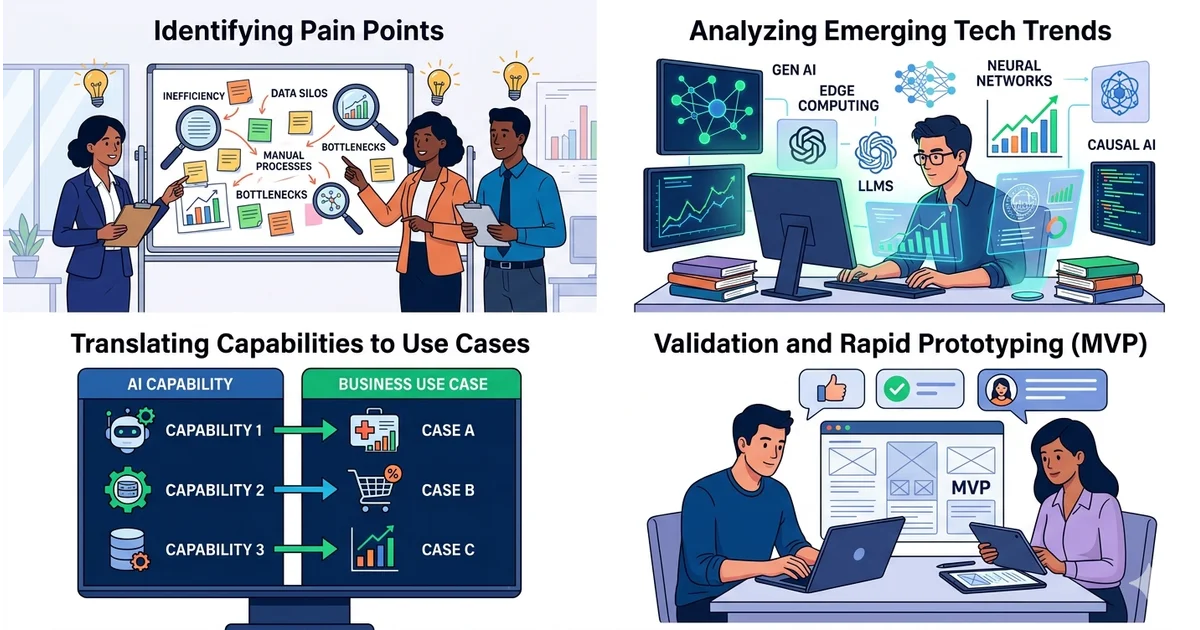
Step 1 — Start With Human Pain, Not Technology
Innovation begins with empathy, not engineering. Spend time in the domain you want to disrupt. Interview practitioners — doctors, logistics managers, teachers, farmers — and ask them one question: “What task do you do every week that you genuinely hate?” High-frequency, high-frustration tasks are AI’s sweet spot.
- Talk to 20 domain expertsin your target industry. Use open-ended questions. Listen for recurring complaints about time-consuming, error-prone, or manual workflows.
- Map the workflowof a professional in that field from morning to night. Identify where bottlenecks form, where errors creep in, and where human judgment is being substituted for automation that doesn’t quite work.
- Quantify the pain. What is the cost of errors? How many people experience this? If the numbers are large, the opportunity is real.
Step 2 — Analyze Trend Intersections
AI innovation rarely emerges in a vacuum. It sits at the crossroads of converging trends. The most durable AI ideas fuse two or more waves at once — for example, the intersection of aging populations (demographic trend) + multi-modal LLMs (AI trend) + wearable biosensors (hardware trend) creates the conditions for AI-powered elder care companions.
| Trend Pair | Emerging AI Opportunity | Market Size Est. (2028) |
| Climate change + Remote sensing | AI-powered carbon footprint verification | $42B |
| Mental health crisis + NLP | Personalized AI therapy assistants | $31B |
| Supply chain fragility + Logistics data | Predictive disruption management AI | $88B |
| Aging population + Computer vision | Falls prevention & home monitoring AI | $19B |
| Teacher shortage + Adaptive learning | AI tutors with curriculum alignment | $64B |
| Drug discovery lag + Protein modeling | AI-accelerated biomarker identification | $120B |
Tools for tracking trends: Google Trends, Exploding Topics, Gartner Hype Cycle, CB Insights Emerging Tech Radar, and academic preprint servers like arXiv.org and PubMed.
Step 3 — Mine Research Papers and Patents
Academic research is the best forward indicator of commercializable AI opportunities. There is typically a 3–7 year lag between a foundational AI paper and its mainstream application. If you can read the research today, you are looking 5 years into the future of the product landscape.
Use these platforms systematically:
| Platform | What to Look For | Signal Type |
| arXiv.org (cs.AI, cs.LG) | Papers with 100+ citations in under 6 months | Technical breakthrough |
| Google Scholar Alerts | New papers on your niche query | Research velocity |
| USPTO / Espacenet | Patents filed by major AI labs in your domain | Commercial intent |
| Semantic Scholar | Highly influential papers not yet commercialized | Whitespace opportunity |
| NIH Reporter / EU Horizon | Funded AI research grants | Government-backed signals |
INPUTS: Trends · Pain Points · Research · DataFILTER: Feasibility · Market Size · CompetitionVALIDATED AI IDEA
Step 4 — Study What AI Cannot Do Yet (But Almost Can)
The most powerful AI ideas live at the frontier of capability — tasks that AI can do at 70–80% accuracy today but not 95%+. When the technology crosses that threshold, massive disruption is possible. Radiologists, contract lawyers, financial auditors, and code reviewers all sit in this zone in 2026. Study current model benchmarks on platforms like Papers With Code and Hugging Face leaderboards to identify these near-frontier tasks.
Step 5 — Reverse-Engineer Competitor Gaps
Existing AI products reveal what customers want. But their 1-star reviews reveal what they are failing to deliver. Systematically read negative reviews on G2, Product Hunt, and Capterra for AI tools in your target category. Every recurring complaint is a product brief for your next innovation idea.
“A bad review on a competitor product is a better market research document than any survey.”— Paul Graham, Y Combinator
Step 6 — Use Structured Ideation Frameworks
Unstructured brainstorming rarely produces breakthrough ideas. Use these tested frameworks to impose productive constraints:
| Framework | How It Applies to AI Ideation | Best For |
| JTBD (Jobs to Be Done) | “What job is the user hiring this AI to do?” | Product founders |
| SCAMPER | Substitute, Combine, Adapt an existing AI tool | Iterative innovators |
| Morphological Analysis | Cross-matrix of AI modalities × industries × use cases | Research teams |
| Blue Ocean Strategy | Identify uncontested AI spaces with low competition | Startups, investors |
| Analogical Reasoning | “How did AI solve this in industry X? Can it apply to Y?” | Cross-domain thinkers |
Step 7 — Validate Before You Build
An idea is worth nothing without validation. Before writing a single line of model code, test the following:
- Search demand test:Does anyone search for a solution to this problem? Use Google Keyword Planner, Ahrefs, or SEMrush to check search volume for problem-related queries.
- Willingness to pay:Create a landing page describing your AI solution. Run $50 in ads. Measure email signups or pre-orders. If no one signs up, the market is weak.
- Expert validation:Show your concept to five domain practitioners. Ask: “Would this tool change how you work?” Their hesitation is as informative as their enthusiasm.
- Feasibility audit:Identify which existing foundation models (GPT-4o, Gemini 2.0, Claude, Mistral, Llama) could power your idea. Estimate compute cost per query at scale using the pricing calculators of major cloud AI providers.
Where to Look: Best Resources for AI Innovation Ideas
Knowing where to look is half the battle. Here is a curated list of authoritative sources that consistently surface pre-mainstream AI opportunities:
| Resource | Type | Why It Matters |
| arXiv.org / cs.AI | Research preprints | 3–7 year preview of commercial AI |
| MIT Technology Review | Editorial journalism | Accessible breakdown of emerging AI breakthroughs |
| Gartner AI Hype Cycle (annual) | Analyst report | Maps AI maturity to commercial readiness |
| Y Combinator Requests for Startups | Investor signal | Lists problem areas investors want AI to solve |
| Reddit (r/MachineLearning, r/artificial) | Community signal | Practitioner frustrations and unsolved problems |
| LinkedIn Learning Communities | Professional signal | Industry-specific AI pain points and requests |
| WHO, UN, World Bank Data Portals | Open data | Global-scale unsolved humanitarian challenges |
Sectors With the Highest AI Innovation Potential in 2026
Not all industries are equally ripe for disruption. Based on current AI capability curves, funding signals, and regulatory tailwinds, these sectors present the most fertile ground for AI innovation ideas right now:
HealthcareDiagnostics, drug discovery, clinical admin — $45B AI spend by 2027
Legal TechContract review, compliance monitoring — $3.1B AI market by 2028
Climate AIEmissions tracking, carbon markets, energy optimization — fastest growing vertical
How to Find AI Innovation Ideas : People Also Ask(FAQ’s)
What is the best way to come up with AI startup ideas?
The most reliable method is to combine deep domain immersion with structured ideation. Spend time talking to professionals in a specific industry, identify recurring manual or error-prone workflows, then cross-reference those pain points with what modern AI models can realistically automate. Validate before building using landing pages and expert interviews.
How do I know if my AI idea is original?
Search Google, Product Hunt, Crunchbase, and the USPTO patent database for your core concept. If you find a dozen well-funded competitors, the idea is probably not original — or you need a more specific niche. A unique combination of target user + modality + outcome can create originality even in a crowded space.
Where do AI researchers get their ideas from?
AI researchers typically generate ideas by closely reading adjacent fields, attending conferences like NeurIPS, ICML, and ICLR, identifying benchmark failures in state-of-the-art models, and collaborating with domain practitioners who identify tasks that existing models handle poorly. arXiv.org is their primary discovery tool.
Can I find AI innovation ideas using AI itself?
Yes — prompting large language models with structured creative frameworks (like SCAMPER or morphological analysis) can surface interesting conceptual combinations. However, AI tools should be used as ideation accelerators, not replacements for domain expertise and real-world problem observation. An AI-generated idea still needs human validation.
What industries have the most unsolved AI problems?
Agriculture, elder care, mental health, legal aid for underserved communities, and climate science consistently top the lists of domains with high need and relatively low AI penetration. These sectors often lack technical talent to articulate problems in ML terms — which creates a gap that outsider innovators can fill.
How important is technical knowledge for finding AI ideas?
Technical fluency helps you assess feasibility, but the best AI ideas rarely come from technologists alone. The most impactful AI innovations in history — from IBM Watson’s oncology tool to Google’s AlphaFold — emerged from partnerships between domain experts who understood the problem deeply and AI researchers who knew how to solve it technically.
Key Takeaways: How to Find AI Innovation Ideas
Finding great AI innovation ideas is a learnable, repeatable skill — not a lightning-bolt moment reserved for genius. The process is systematic: start with human pain, track trend intersections, read research aggressively, audit competitor weaknesses, apply structured frameworks, and validate before committing resources. The AI economy in 2026 is large enough to reward thousands of new entrants — but only those who solve problems that genuinely matter, at a scale that justifies AI as the tool of choice.
The question is whether you are willing to do the upstream work of truly understanding the problem before reaching for the model.
Authoritative References
- Statista (2025). Global Artificial Intelligence Market Revenue Forecast to 2030. statista.com
- McKinsey Global Institute (2025). The State of AI: Global Survey Results. mckinsey.com
- CB Insights (2024). Why AI Startups Fail: A Post-Mortem Analysis. cbinsights.com
- Accenture (2024). AI-First Business Returns: Quantifying the AI Advantage. accenture.com
- Ng, A. (2023). AI Fund Portfolio Principles. aifund.ai
- Gartner (2025). Hype Cycle for Artificial Intelligence. gartner.com