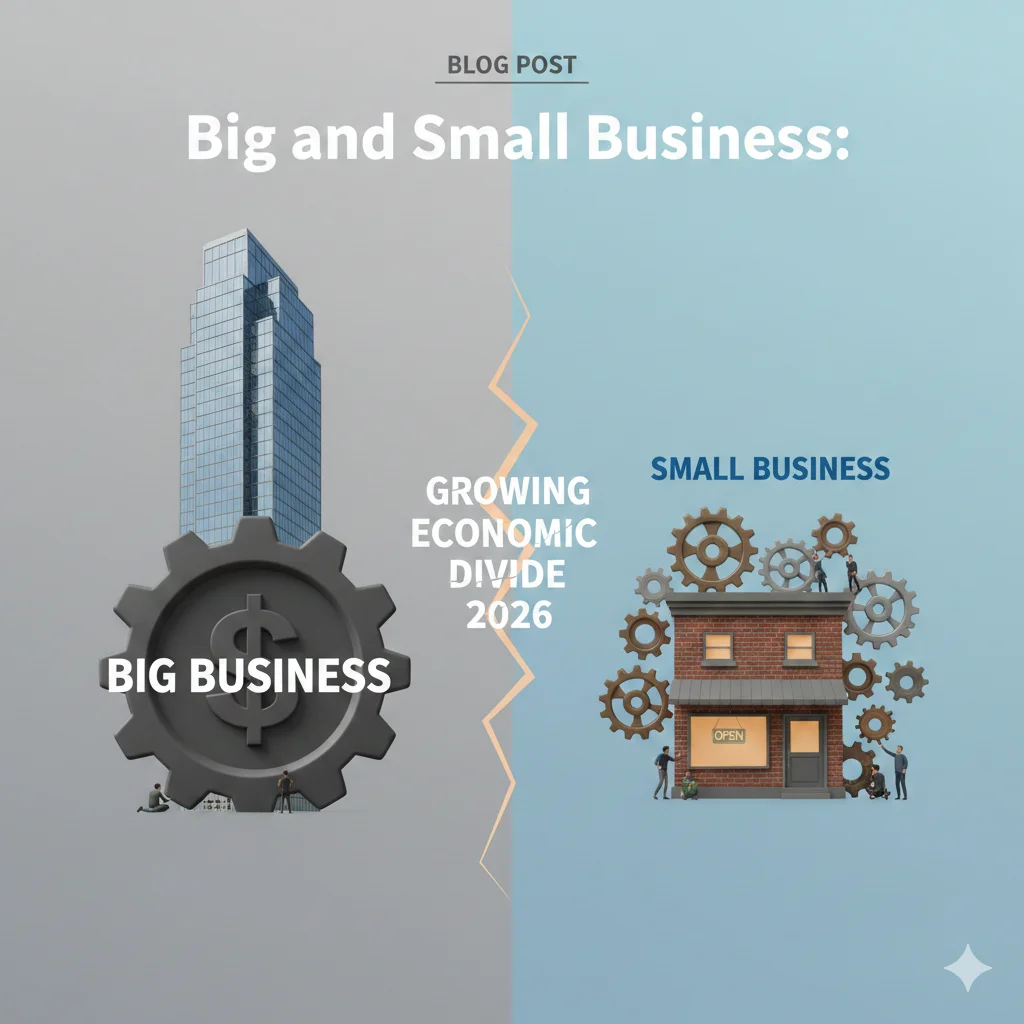
Big and Small Business: Growing Economic Divide 2026
In 2026, the economic landscape is shifting rapidly. While large corporations continue to grow through technological advancements and capital advantages, small businesses face mounting challenges that widen the economic gap between the two. This divide doesn’t just impact business owners — it has broader implications for employment, innovation, community resilience, and national economic stability. This blog explores the root causes, current trends, and potential solutions for bridging the economic divide between big and small businesses.
Understanding the Big vs. Small Business
Large enterprises and small businesses are both essential to a healthy economy. Big corporations generate substantial revenue, influence global markets, and create millions of jobs. Small businesses — including micro, small, and medium enterprises (MSMEs) — are the backbone of local economies, drive community engagement, and fuel innovation. Yet, by 2026, the divide between them is widening due to differences in access to capital, technology, market reach, and policy support. Understanding this divide is crucial to fostering a more equitable economy for all.
The Economic Contributions of Big and Small Businesses
The Role of Large Corporations
Large businesses — think multinational corporations and industry giants — wield significant economic power. With vast resources, established brand recognition, and global reach, they benefit from economies of scale that drive down costs and increase profitability. These corporations:
- Employ large segments of the workforce.
- Invest heavily in research and development.
- Drive export markets and international trade.
- Influence policy decisions through lobbying and economic clout.
Their scale allows for substantial investment in new technologies, such as artificial intelligence (AI), automation, and advanced analytics. By integrating these technologies at scale, larger companies can boost productivity and expand into new markets faster than smaller competitors.
The Importance of Small Businesses
Small businesses make up a significant proportion of the global economy. In many countries, they represent the majority of total business establishments and contribute a large share of employment and value added to GDP. For example, MSMEs are a major source of jobs and innovation worldwide. They:
- Support local communities and keep money circulating locally.
- Offer niche products and personalized services that large firms often overlook.
- Are flexible and quick to adapt to changes in customer preferences.
- Act as incubators for future entrepreneurial growth.
Despite this importance, small businesses struggle with challenges that limit their growth relative to larger corporations.
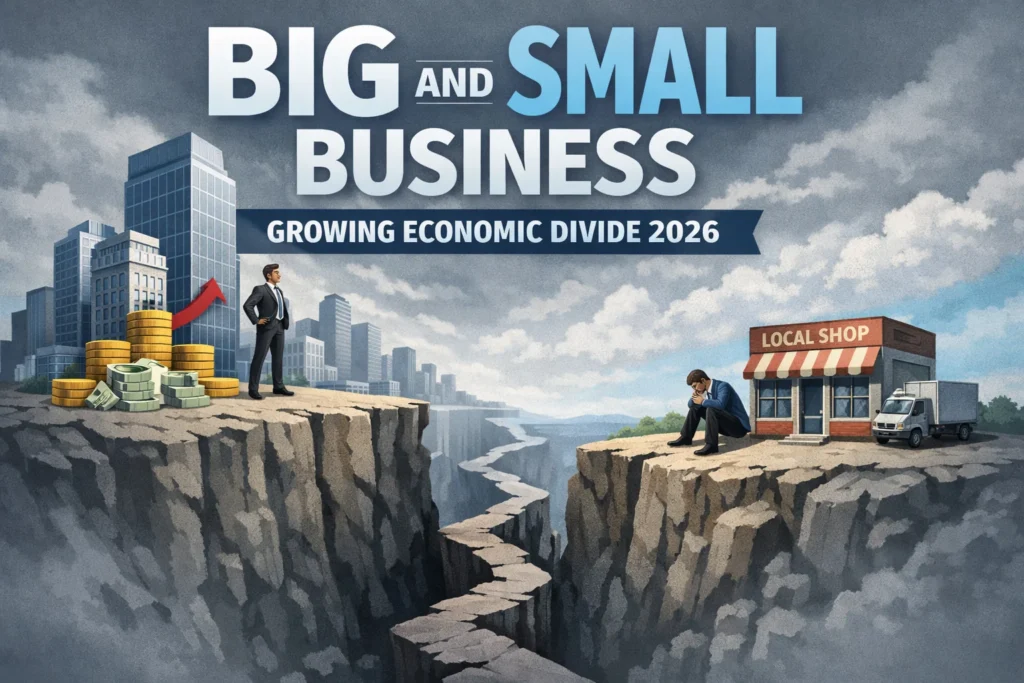
What’s Driving the Economic Divide in 2026?
Access to Capital and Financial Challenges
One of the most significant drivers of the divide is unequal access to capital. Large businesses typically have more robust credit histories, greater collateral, and easier access to loans and investment capital. In contrast, small businesses often find borrowing challenging due to strict lending standards and higher perceived risk. In many economies:
- Traditional banks offer less credit to small firms.
- Venture capital and investment funds tend to favor larger, more scalable ventures.
- Alternative financing (such as crowd funding or fintech lending) is growing, but still not at parity with large-company access. news.linkedin.com
Without adequate capital, small businesses struggle to invest in growth, technology, and talent — deepening the divide.
Technological Disparities
Another major factor is technology adoption.
Large corporations often have the resources to implement cutting-edge technologies — from AI to predictive analytics to cloud computing. These tools help optimize operations, reach new customers, and drive innovation at scale.
Small businesses, on the other hand, face obstacles such as:
- Limited budgets for technology investment.
- Lack of in-house IT expertise.
- Challenges in scaling digital solutions across the business.
While technologies like AI are becoming essential for competitiveness, small businesses still lag in adoption rates compared with large firms. This technology gap reinforces differences in efficiency, innovation capacity, and market responsiveness. Forbes
Market Reach and Globalization
Large corporations operate globally and benefit from diversified revenue streams across markets. They can leverage global supply chains, negotiate favorable contracts with suppliers, and absorb economic shocks more easily.
Small businesses typically serve local or regional markets. Although technology and digital platforms now enable some small firms to reach international customers (e.g., becoming “micro-multinationals”), most still struggle with barriers like logistics, tariffs, and marketing costs. icsb.org
Key Trends Shaping the Business Divide in 2026
Rising Importance of AI and Technological Tools
Artificial Intelligence is a major productivity driver in 2026. It enables businesses to automate processes, improve customer service, and make smarter decisions. Some reports highlight that AI not only provides competitive advantages to large firms but also has the potential to be an “equalizer” for small enterprises that adopt it effectively. icsb.org
However, the divide persists because access to AI and the talent to implement it is uneven — a factor that strengthens big businesses’ competitive edge.
Small Business Resilience and Innovation
Despite challenges, small businesses continue to innovate. More are using digital tools to streamline operations, reach customers, and build brands. Some small businesses are leveraging global platforms to market products internationally from day one. icsb.org
Technology, especially human-centered AI, helps small firms punch above their weight by amplifying creativity, improving customer engagement, and optimizing operational efficiency.
Ongoing Financial Pressures and Economic Policies
Small businesses continue to face financial pressures, including higher operational costs, cash flow management concerns, and uneven access to funding. In some countries, surveys reveal that small firms are still struggling with cash flow problems, rising costs, and regulatory hurdles — making their recovery and growth more difficult relative to large firms. Upwork
Government policies (such as tax reforms or small business incentives) have the potential to narrow this divide — but without targeted support, small firms may fall further behind.
Big and Small Business: Growing Economic Divide 2026: Impacts of the Growing Divide
On Employment and Local Economies
Small businesses are major employers, especially in local and rural communities. A widening divide can lead to:
- Job loss and stagnation in local markets.
- Declining consumer confidence when small firms downsize.
- Erosion of community character and economic diversity.
Large corporations often centralize operations, which can create job concentration in urban centers while leaving small markets underserved.
On Innovation and Competition
Healthy competition spurs innovation. When small firms are constrained by financial and technological hurdles, the marketplace becomes less dynamic. Large companies might innovate at scale, but small businesses often bring radical, niche-focused ideas that drive differentiation and diversity in the economy.
On Social and Economic Equity
The widening business divide also has sociopolitical implications. Small business owners are often local leaders and job creators in underserved communities. If they are unable to compete, the result can be:
- Increased economic inequality.
- Reduced opportunities for aspiring entrepreneurs.
- Concentration of wealth and market power.
Strategies for Closing the Divide
Policy Interventions and Government Support
Governments can play a pivotal role by:
- Improving access to financing for small enterprises.
- Offering tax incentives and regulatory relief.
- Supporting digital adoption through grants or training programs.
- Ensuring fair competition in markets dominated by large firms.
Such policies help level the playing field and promote broader economic participation.
Leveraging Technology as a Bridge
Small businesses can adopt scalable, affordable technology solutions to streamline operations and reach global audiences. Cloud computing, automation tools, and AI — even in scaled-down forms — can drastically improve competitiveness.
Training programs and partnerships can help small-business owners and employees build the skills needed to thrive in a digital economy.
Collaboration Between Big and Small Players
Rather than viewing the divide as purely competitive, large businesses can partner with small firms through:
- Supply chain partnerships.
- Shared innovation programs.
- Mentorship and funding initiatives.
Collaborative ecosystems benefit both sides, increasing efficiency and expanding market reach.
Big and Small Business: Growing Economic Divide 2026: People Also Ask (FAQs)
Q: Why do large companies grow faster than small businesses?
Large companies benefit from economies of scale, established brand recognition, robust capital access, and advanced technology — advantages that allow them to grow faster and invest more aggressively in expansion and innovation.
Q: What challenges do small businesses face in 2026?
Small businesses often struggle with cash flow management, limited financing, difficulty hiring skilled talent, rising costs, and slower adoption of advanced technologies — all contributing to slower growth relative to large enterprises. Upwork
Q: Can technology help small businesses catch up?
Yes — digital tools, e-commerce platforms, and AI can help small businesses become more efficient, reach new customers, and innovate. However, access to technology and skills is uneven, which means support and training are essential for widespread adoption. icsb.org
Q: What role do governments have in addressing the business divide?
Governments can offer tax incentives, improve financing access, reduce red tape, and create programs that support digital transformation and competitiveness for small businesses.
Big and Small Business: Growing Economic Divide 2026
The economic divide between big and small businesses continues to grow in 2026 — fueled by capital disparities, technological shifts, and market dynamics. Although big corporations will likely continue to lead in scale and influence, there is a clear path forward for small firms to thrive too. Through supportive policies, equitable access to technology, and collaborative ecosystems, the divide can narrow — benefiting not just businesses themselves, but the wider economy.